




Canada’s largest outdoor military aircraft display — and a Tim Hortons right under the airport flight path. All within Winnipeg, free, and open year-round.
It was an ordinary Sunday evening. Eight o’clock, the weekend winding down, the work week ahead. You know that feeling when you want to steal a little more of the weekend for yourself before everything starts spinning again? Not a big plan, not a trip — just something light, to breathe out.
We have a place for evenings like that. And today I want to tell you about it, because it is probably one of the simplest and most pleasant evening ideas in Winnipeg that almost no one mentions.
Anna did not need much convincing — two minutes to get ready. Another five went into explaining to our dachshund Nika that we would be back soon (she did not believe us, of course). And off we went. We live five minutes from the place, so the AC had not even beaten the almost-summer heat in the car before we were already ordering coffee.
Stop One: A Tim Hortons Under the Runway
It sounds odd — “let’s drive to a Tim Hortons to enjoy the view.” But that is exactly it.
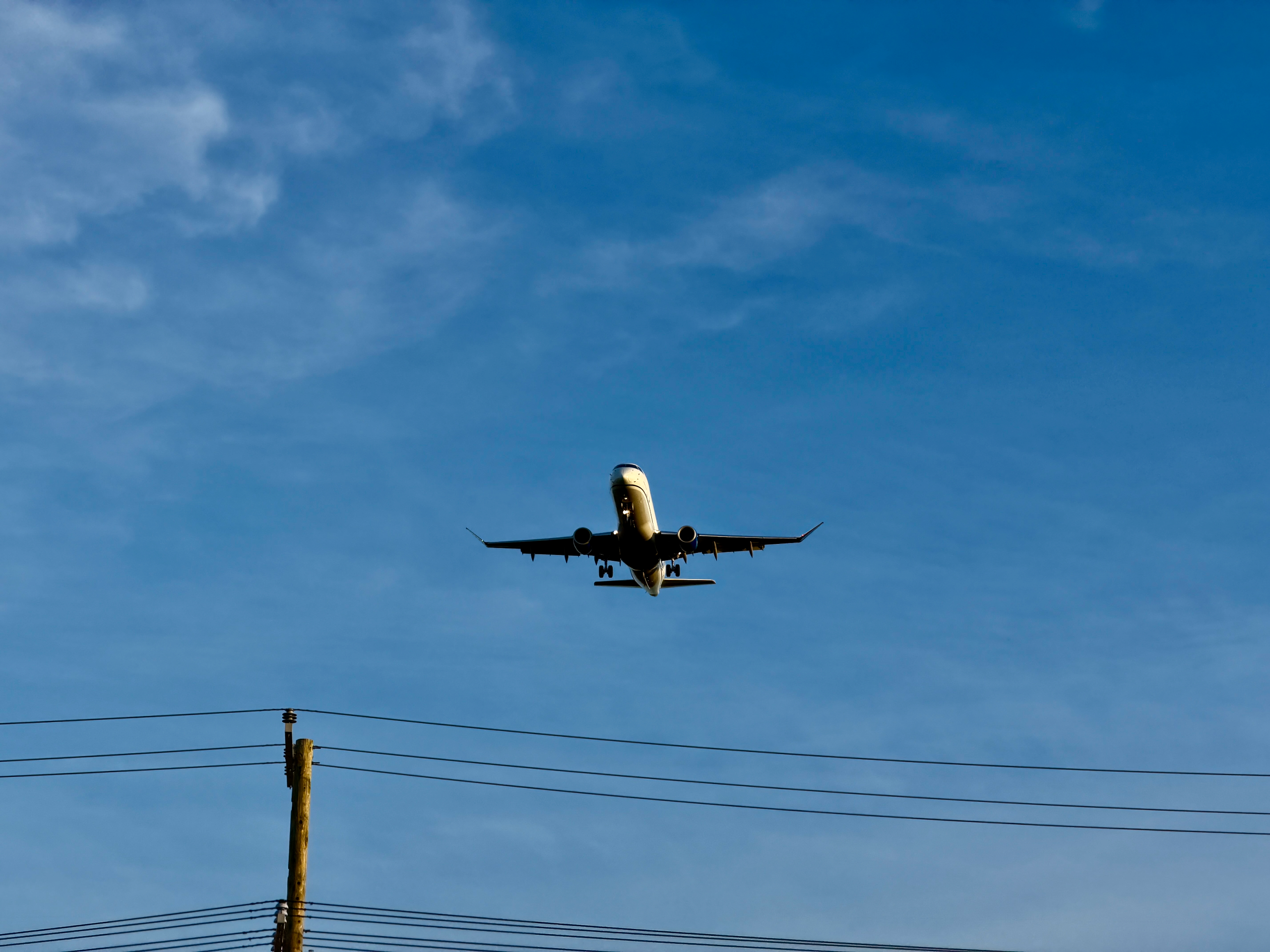
At 2117 Ness Ave there is a Tim Hortons that sits practically under the landing and takeoff path of Winnipeg airport. You grab a coffee, step out into the parking lot — and overhead, low, a real plane comes in to land. And another. And another.
There is convenient parking and a spot from which to watch it all in peace. The place itself is always clean, the staff friendly, and it is usually not crowded. But in the evening, it often fills up with people like us — people who came not so much for the coffee as for the show.
A separate bonus is foggy or low-visibility weather. On days like that, they switch on the additional approach lights on the runway, and the whole atmosphere gets even more dramatic. A plane emerges from the fog right above you — the kind of thing you will not catch in every video online.
Thirty minutes of relaxed conversation, three planes taking off right over our heads, coffee in hand — and the evening already felt like a success. But that was only part one.



Stop Two: The Air Force Heritage Air Park
Two to five minutes from that same Tim Hortons, at 186 Air Force Way, there is an open-air aviation museum. And honestly, it is the main reason this spot became our favourite.
The Air Force Heritage Museum and Air Park is an open park beside the 17 Wing air base, where combat and training aircraft of the Royal Canadian Air Force — from the Second World War to today — are displayed on pedestals and on the ground. The museum was founded in 1975, and the park’s memorials opened in 1999. It is the largest outdoor military aircraft display of its kind in Canada.
The park is open around the clock, 365 days a year, admission is free, with convenient parking, benches, and paths. The place is not very popular — and in my view, that is only a plus. You will not find crowds here. You can rest in peace, clear your head, touch a piece of history, and look at real Canadian aircraft without anyone jostling you.
We arrived with coffee in hand right at sunset. And here is the interesting thing — against the evening sky, these iron birds on their pedestals look as if they froze mid-way through their last flight. You move from one to the next, read the plaques, and find yourself stopping involuntarily to imagine them once soaring through the sky. We walked for about fifty minutes, explored every exhibit, read every plaque, googled a few things on the spot — and drove home.
And for you, we gathered the most interesting things we could find about each aircraft. Because behind every one of them is a separate story, and some of them will surprise you.


What’s on Display
Each exhibit has a plaque with technical specs and history. Here are the main aircraft of the park — about fourteen machines plus a radar antenna.
CF-104 Starfighter — the “Widowmaker” the Pilots Never Called That
Probably the most legendary aircraft in the park. The CF-104 is the Canadian version of the American Lockheed F-104, built under licence by Canadair. Designed as a high-speed, high-altitude interceptor, in the Canadian forces it was used mostly for low-altitude strikes on ground targets.
The press nicknamed it the “Widowmaker” because of its high accident rate — over its service life, Canada lost about 110 aircraft and 37 pilots. But here is a detail few people know: the pilots themselves hated that name and never used it. Among themselves, they jokingly called it the “Lawn Dart” or just “the one-oh-four.”
And yet, in combat effectiveness, it had few equals. Thanks to its small size, speed, and flights at around 30 metres of altitude, the CF-104 was an extremely difficult target. At NATO’s Red Flag exercises, no Canadian Starfighter was ever “shot down.”
Engine: Orenda (GE) J79 with afterburner. Max speed: Mach 2 (2,330 km/h). Ceiling: 17,680 m.


CF-101B Voodoo — the Interceptor That Brought Down a Government
This heavy twin-engine interceptor, built by McDonnell, replaced the Canadian CF-100 and for decades was the backbone of the country’s air defence within NORAD. Voodoos stood on five-minute Quick Reaction Alert, ready to scramble in any weather — pilots even slept in full gear.
But the most controversial detail of its history is the armament. Its primary weapon was the unguided AIR-2A Genie rocket with a nuclear warhead, meant to detonate in front of a formation of enemy bombers. The question of stationing nuclear weapons in Canada caused such a political storm that in April 1963 it effectively brought down the Diefenbaker government. Imagine the scale — the aircraft standing in front of you now in a quiet Winnipeg park was once at the centre of a national political crisis.
In its entire service, the Voodoo never fired a weapon in combat. Canada operated 66 of them until the early 1980s, when they were replaced by CF-18 Hornet fighters.
Engines: 2× Pratt & Whitney J57 with afterburner. Max speed: ~2,120 km/h. Range: up to 3,570 km.


CF-100 Canuck — the Only Canadian Fighter to Reach Mass Production
The pride of Canadian aviation. The CF-100, affectionately nicknamed “Clunk” (after the sound the front landing gear made retracting after takeoff), is the only Canadian-designed fighter to enter mass production. It was built by Avro Canada to patrol the vast spaces of the Canadian North in any weather.
It was flown by a crew of pilot and navigator, with an advanced-for-its-time radar in the nose. And although the Canuck was not officially considered supersonic, in December 1952 test pilot Janusz Żurakowski broke the sound barrier in a dive — making the CF-100 the first straight-winged jet aircraft to achieve controlled supersonic flight.
A total of 692 were built, some of which even served in Belgium. Designed for 2,000 flight hours, the Canuck’s airframe actually withstood over 20,000 — a true survivor.
Engines: 2× Avro Orenda 11. Max speed: ~1,030 km/h. Ceiling: 14,020 m.


CX-144 Challenger — the Only One in Canada
A special star of the collection — this is the only Challenger on display in Canada. More than that, this particular machine is the second prototype built by Canadair, used exclusively for testing and evaluation.
The Challenger was the world’s first wide-body business jet, letting passengers walk upright through the cabin, and one of the first aircraft with a supercritical wing. The series began with an idea from American Bill Lear, creator of the Learjet, which Canadair completely reworked. This aircraft first flew on March 17, 1979, served at the test centre at CFB Cold Lake in Alberta, and was retired in 1993. The civilian Challenger line later gave rise to the famous Canadair Regional Jet.
Engines: 2× Textron Lycoming ALF-502L. Max speed: ~851 km/h. Range: 6,371 km.


F-86 Sabre Mk VI — the Pilots’ Favourite
A classic early Cold War jet fighter, built by Canadair. The Canadian Mk VI version got the powerful Canadian-designed Orenda 14 engine, making it one of the best Sabre variants in the world. With its swept wing and six .50-calibre machine guns, the Sabre was extremely manoeuvrable and a pilot favourite. Canadian Sabres served with NATO forces in Europe and laid the foundation for the postwar Canadian air force.
Engine: Orenda 14. Max speed: ~1,123 km/h. Ceiling: 16,490 m.


CF-116 Freedom Fighter — the Workhorse
The Canadian version of the legendary Northrop F-5, assembled under licence by Canadair. Small, light, and easy to maintain, the CF-116 served simultaneously as a strike aircraft, a reconnaissance plane, and an advanced trainer. Two afterburning turbojets let it reach Mach 1.4. Thanks to its simplicity and reliability, this type became the workhorse for training Canadian fighter pilots.
Engines: 2× J85-CAN-15 with afterburner. Max speed: Mach 1.4. Ceiling: 15,545 m.

CT-133 Silver Star — the Long-Liver
One of the longest-serving aircraft in the history of the Canadian air force. The CT-133 (the Canadian licensed version of the T-33 Shooting Star), built by Canadair with a Rolls-Royce Nene 10 engine, was the primary jet trainer for many generations of pilots. Beyond training, the Silver Star was used for photo reconnaissance and electronic warfare. Simple, reliable, and recognizable by its distinctive wingtip fuel tanks.
Engine: Rolls-Royce Nene 10. Max speed: ~965 km/h. Ceiling: 14,478 m.


CP-121 Tracker — the Submarine Hunter
This sturdy twin-engine piston aircraft was built by de Havilland Canada under licence from Grumman. Its job was hunting submarines. The Tracker took off from Canadian aircraft carriers and shore bases, patrolling the ocean. It carried rockets, depth charges, and torpedoes. It served faithfully for over three decades — from 1957 to 1991.
Engines: 2× Wright R-1820-82. Max speed: ~520 km/h. Range: 2,172 km.


Harvard Mk.4 — a Second World War Icon
A true icon of the Second World War era. Thousands of pilots learned to fly on the “Harvard” under the British Commonwealth Air Training Plan (BCATP) — a program honoured with its own memorial in this very park. Equipped with a 9-cylinder Pratt & Whitney radial engine, this aircraft, with the distinctive loud “growl” of its propeller, served in the Canadian forces for nearly three decades. You cannot mistake it in the sky.
Engine: Pratt & Whitney R-1340 (600 hp). Max speed: ~331 km/h. Ceiling: 6,560 m.


CH-136 Kiowa — the Only Helicopter
The only helicopter in the collection. The light and agile CH-136 Kiowa, built by Bell Helicopter Textron, was used by the Canadian military for reconnaissance, observation, and tactical transport. Despite its small size, it could carry a minigun and rockets. With its single Allison gas-turbine engine, it was simple to operate and a reliable helper to ground troops.
Engine: Allison T63-A-700B (317 hp). Max speed: ~222 km/h. Range: 490 km.


CT-134A Musketeer II — a Pilot’s First Step
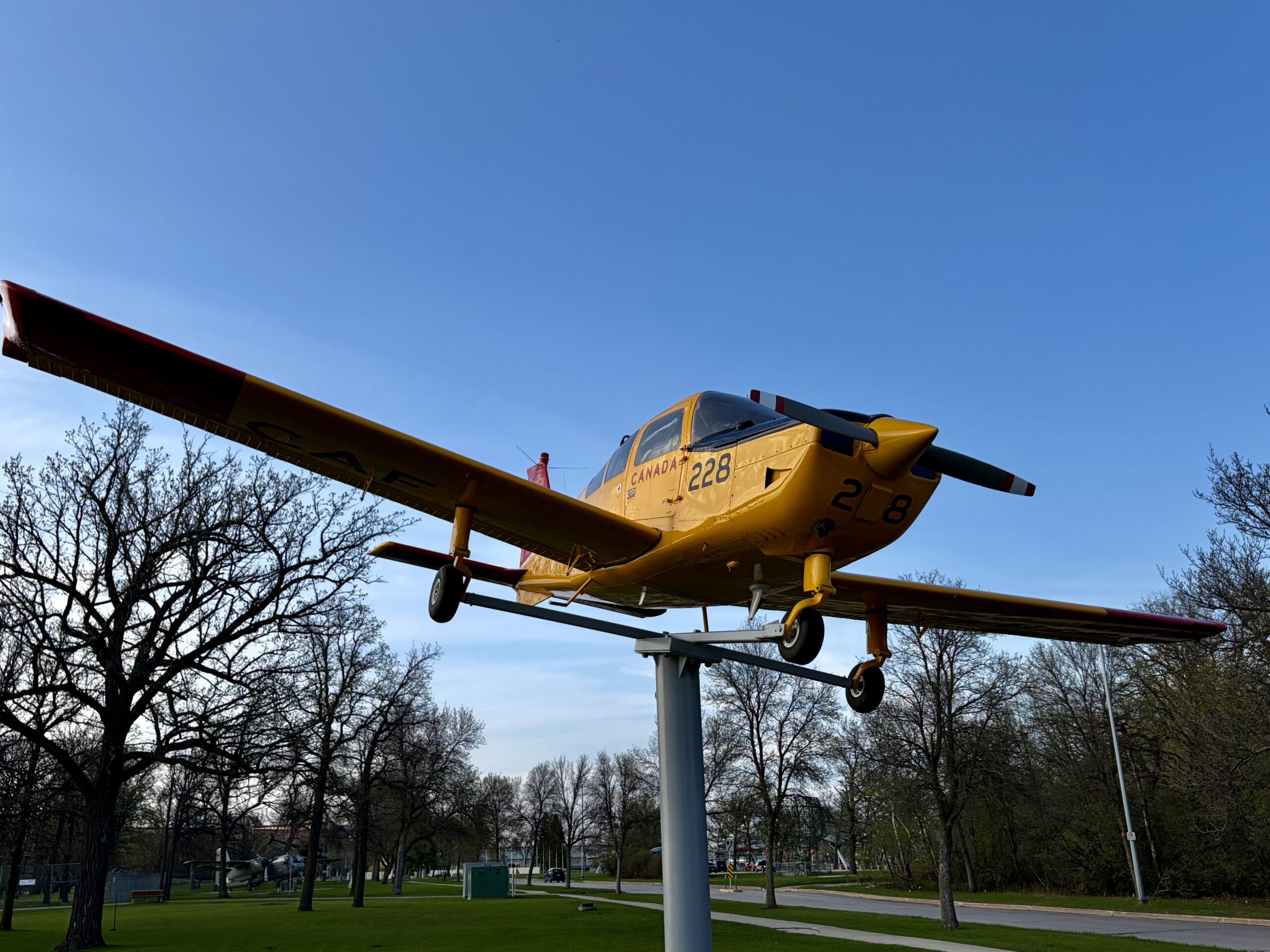
This is the aircraft that greets visitors at the entrance from the Silver Avenue side. The small propeller-driven Musketeer (based on the Beech Sundowner 180) was the primary trainer for student pilots of the Canadian Armed Forces in the 1980s. On it, future aviators made their first solo flights before moving on to jets. A modest but important first step in the careers of many Canadian pilots.
Engine: Avco Lycoming O-360 (180 hp). Max speed: ~252 km/h. Ceiling: 4,160 m.


AN/FPS-508 — a Cold War Radar
Not an aircraft, but no less important an exhibit. This parabolic antenna rotated 360 degrees at five revolutions per minute and could detect aircraft up to 30 kilometres high and over 320 kilometres away. It was installed in 1997 as a historic symbol of the long-range detection stations of the CADIN/PINETREE line, which operated in Canada from 1953 to 1988. It is a tribute to the air force men and women who served at these radar posts throughout the Cold War, providing data for NORAD’s air defence.


What to Know Before You Go
The park is open around the clock and year-round, so you can come whenever you like. There is free parking at both locations. Coffee is at the Tim Hortons on Ness Ave, right before the walk. You need nothing else: no tickets, no bookings, no gear. You just show up and walk.
When to Go
In the evening. This is the best time for two reasons at once. First, the sunset makes both the aircraft in the park and the landings by Tim Hortons far more dramatic. Second, it is in the evening that other plane-spotting enthusiasts gather by the Tim Hortons — the atmosphere comes alive.
The park is open year-round and around the clock, so technically you can come whenever you like. In winter, the walk between the aircraft will be colder, but atmospheric in its own way — especially when snow settles on the wings. In foggy weather, the approach lights put on their own show by the Tim Hortons.
Who This Place Is For
- Aviation lovers — obviously. Fourteen real aircraft you can walk right up to
- Families with kids — children love both the park and the planes landing overhead
- Anyone who needs to breathe out — a quiet park with no crowds, perfect for a reset
- History fans — behind every plane is a piece of Canadian history, the Cold War, NORAD
- Dog owners — open park, you can walk with a dog
- Anyone short on time — it is all within the city, easily done in one or two hours
Quick Reference
| What | Details |
|---|---|
| Air Park address | 186 Air Force Way, Winnipeg |
| Tim Hortons (spotting) | 2117 Ness Ave, Winnipeg |
| Park entry | free, 24/7, year-round |
| Collection | ~14 aircraft + radar antenna |
| Highlight | only Challenger in Canada; largest display of its kind |
| Parking | free, at both locations |
| Best time | evening (sunset + plane landings) |
| Dog-friendly | yes, open park |
Why It’s Worth It
The best thing about this place is that it asks nothing of you. No planning, no booking, no route to map out. You just grab a coffee, watch a plane come in to land right over your head, then walk among real fighter jets at sunset — and drive home feeling the evening was spent the right way.
For us, it became the place we go when we want a little quiet before the work week. No pretensions, no program — just coffee, planes, and good company.
If you live in Winnipeg or are passing through — give it a try. And if you like these short, unplanned outings, we have a separate post about the forty-minute rule. Although this time, five minutes were enough.