



We thought we were driving to see friends in Gimli. The pin on the map sent us a little farther — to a village we’d never heard of, and it turned out to be the quietest find of our summer.
Friends had invited us to their son’s birthday. They live in Gimli, and we’ve been up there more than once, so we settled in for a familiar drive. But the coordinates in Google Maps weren’t pointing at Gimli itself — they landed a little to the south, about 24 km away, a twenty-minute drive along the shore. We didn’t Google the place, didn’t read reviews, didn’t plan a single thing. We had one goal: show up and wish the birthday boy well. Everything else could sort itself out.
As it turned out, “everything else” this time meant Dunnottar — new to us and, as we quickly learned, badly underrated.
Where is Dunnottar, and what is it?
Dunnottar is a small village on the southwest shore of Lake Winnipeg, roughly a 45–55 minute drive north of Winnipeg on PTH 9. Technically it’s one village, but it’s made up of three historic communities — Matlock, Whytewold, and Ponemah — that grew up around Canadian Pacific Railway stations more than a century ago.
The name is pronounced “Dun-NOTT-er” (locals like to say it rhymes with daughter) and comes from Dunnottar Castle in Scotland — suggested by architect Alex Melville, whose hometown sat not far from the real castle. The village was officially incorporated in 1948, but for more than half a century before that it was a summer escape for well-to-do Winnipeggers, who arrived by train right up until the late 1950s.
One more useful detail for anyone, like us, heading “out toward Gimli”: Dunnottar to Gimli is only about 24 km — a 20-minute drive up the shoreline. The two pair together easily in a single day.
First impressions: quiet, green, and easy on the eye
The scenery started pulling us in before we’d even arrived. The village is deeply green: lots of trees, narrow tucked-away streets, tidy houses, and a few small, characterful cafés and shops.
We’re not big-city people — most of our trips are really about quiet places to reset. Dunnottar turned out to be exactly that kind of spot. After the birthday and all the hellos, we slipped out for a walk, because we wouldn’t be us if we didn’t look around wherever we land.
Fresh air, complete quiet, birdsong, the sun leaning toward the horizon. Calm you can’t buy, basically.
The highlight: the lakefront and a wooden pier
Then the walk led us down to the water, and that became the evening’s real find.
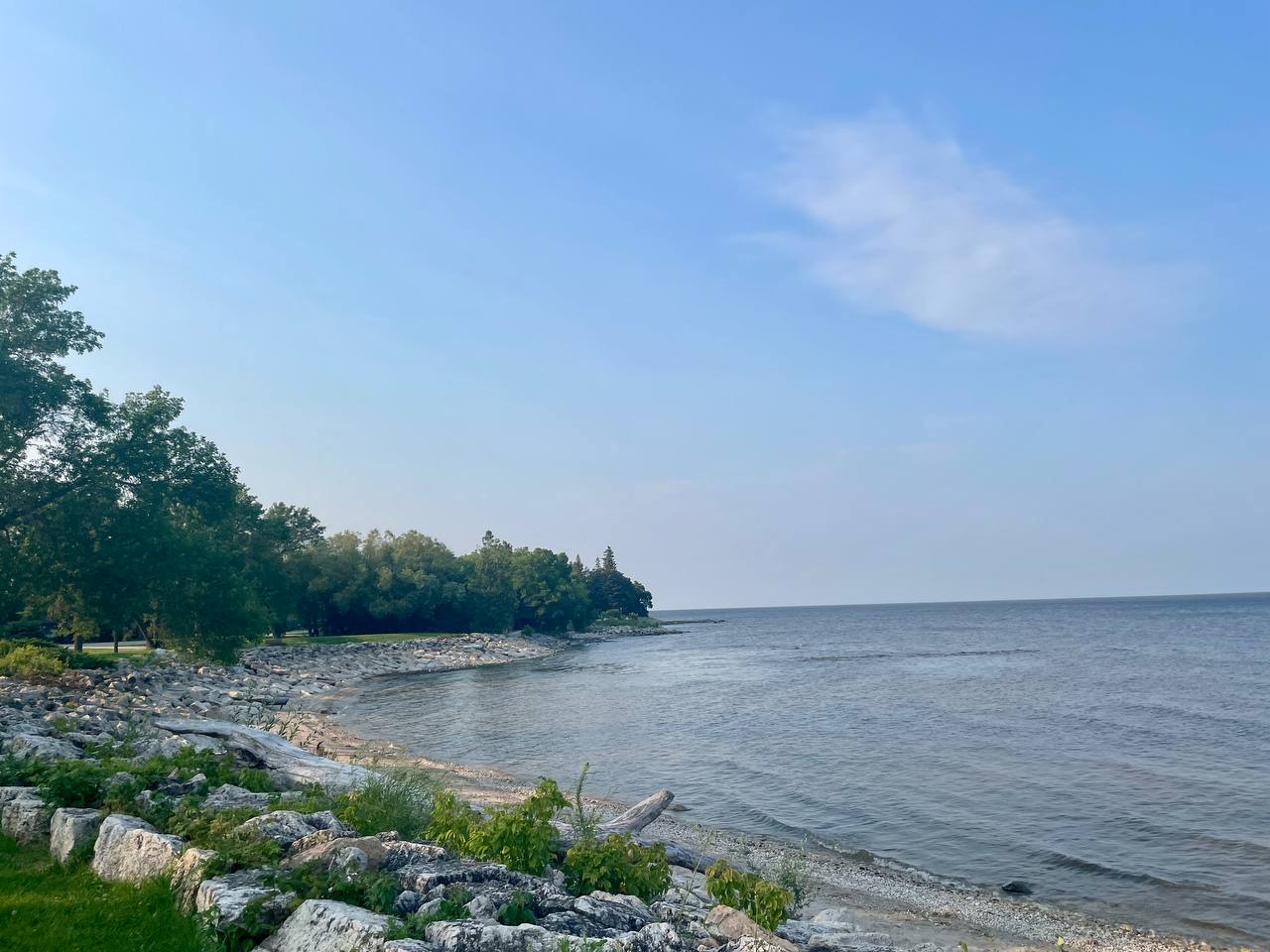
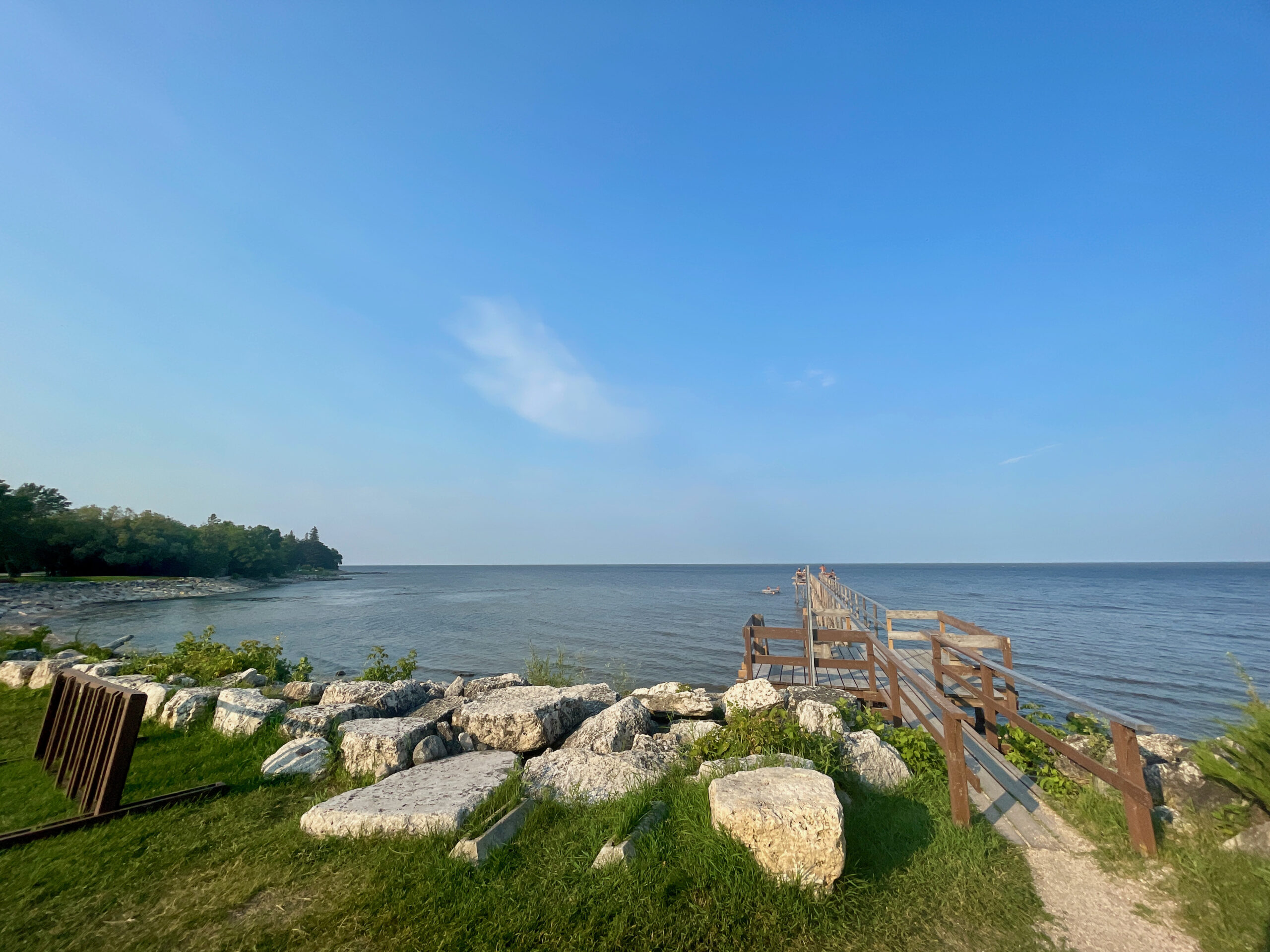
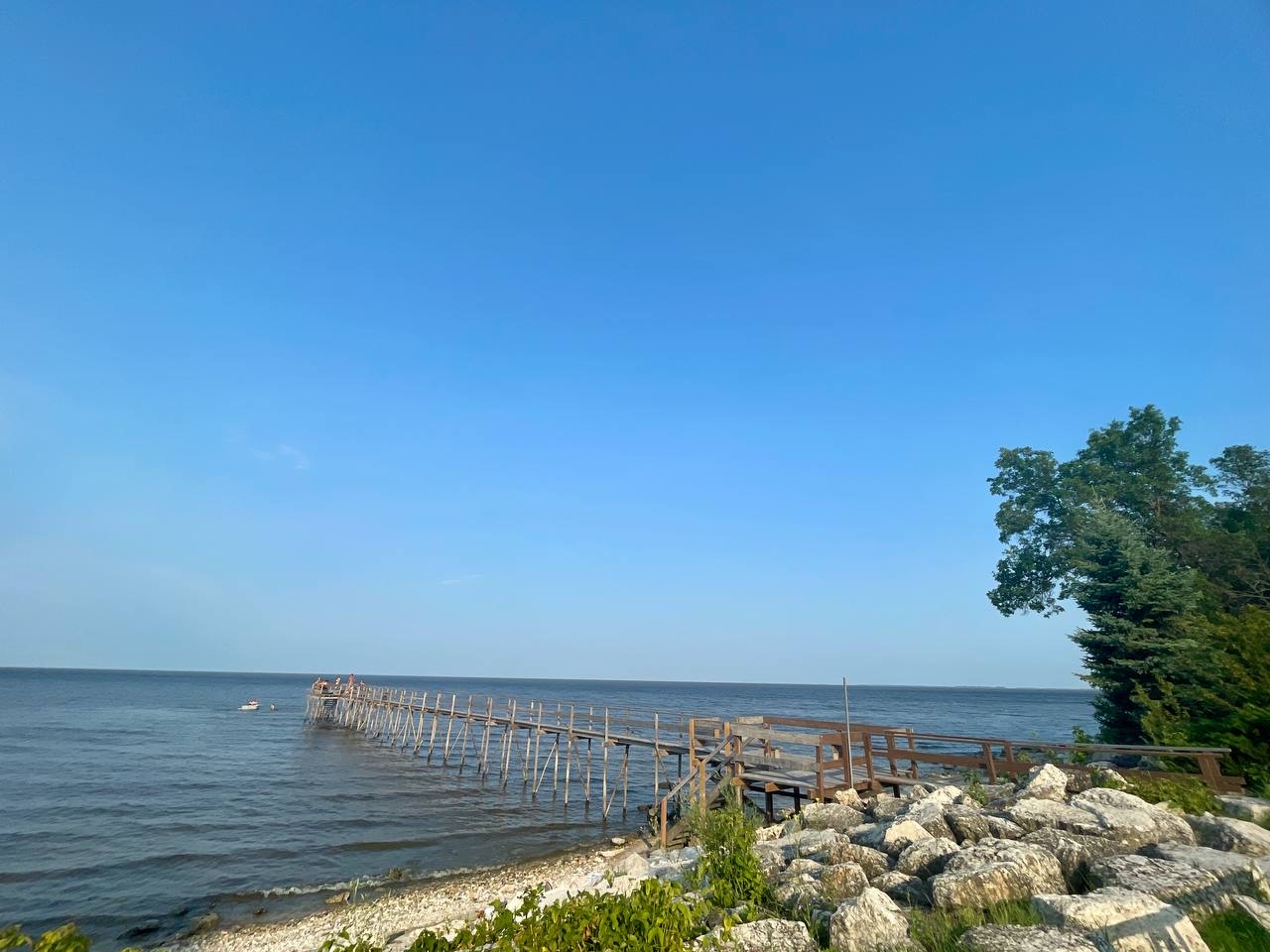
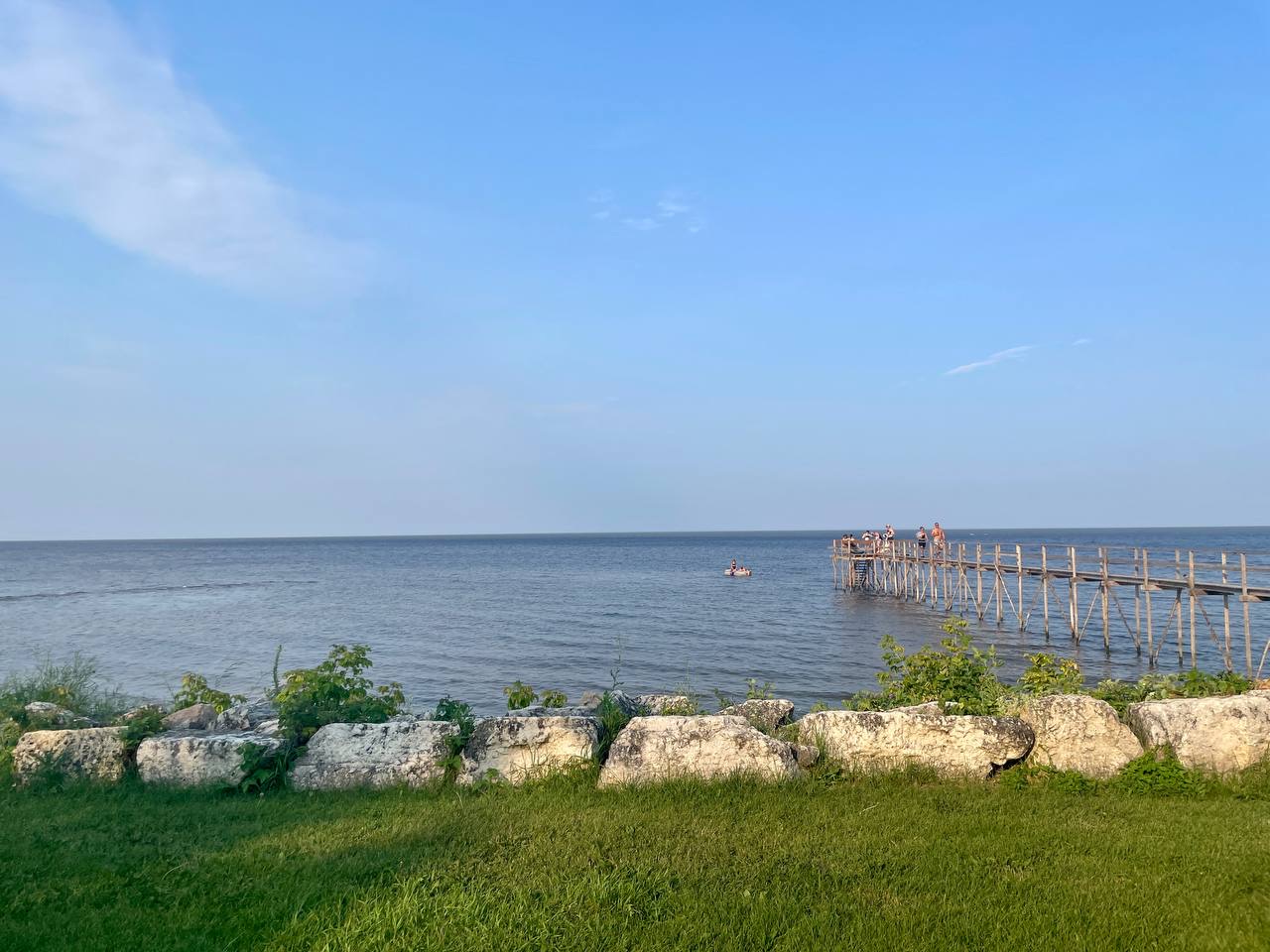
The shore is lined with big limestone boulders, and around them people were swimming, kids were poking about and collecting stones. A long wooden pier ran out into the lake, and here’s the striking part: people were standing waist-deep in the water right at the far end of it. Lake Winnipeg is very shallow here, so you can wade a long way out — it probably only gets properly deep somewhere past the pier.
We don’t actually know the name of the pier we walked out to — and honestly, there’s a charm in that. Because in Dunnottar the piers aren’t anonymous: each one has its own name — Milne, Matlock, Bowling Green, Tugela, and more. These wooden piers are the village’s signature. They’re put in every spring and pulled out every fall, because winter ice would simply destroy them; the village even publishes an “up / down” schedule for each one. So if you come in late autumn or winter, the piers won’t be on the water — catch them while it’s summer.
Along the shore, set among the greenery, there’s a bench to sit and catch your breath, and a small path that a few unhurried people were wandering along — probably out for the same kind of evening. It’s the sort of place that just makes you want to stop. The water was warm, but we hadn’t come dressed for a swim — so we simply walked the shoreline, and that was plenty.
Three beaches, a well, and where to eat
If you’d rather spend more than one evening here, Dunnottar has three public beaches — Bowling Green Park, Tugela Creek Park, and Milne Park (home to those famous piers). There’s also a local artesian well on Gimli Road that people drive to for water.
You won’t go hungry, either: the Whytewold Emporium has a restaurant nearby, and Matlock has a general store for basic groceries and fishing tackle. For a bigger shop or a proper dinner out, neighbouring Winnipeg Beach is a short drive away.
Can you stay overnight in Dunnottar?
Yes. Tiny as it is, Dunnottar has plenty of houses and cottages available to rent — from private cabins right on the shore to small bed & breakfasts. The village’s population swells noticeably in summer precisely because of visitors, so there are options for a short stay by the water. If you’re after a quiet weekend in the country with no crowds, this is one of those spots worth keeping on your list.
So, is it worth the drive?
Honestly? We ended up here by accident, spent a single evening, and saw nothing “touristy” in the usual sense. But that’s exactly the point of Dunnottar: you don’t come for attractions, you come for the quiet, the shore, and the air.
It’s a trip in the spirit of our 40-minute rule for spontaneous drives — when the best evening happens with no plan at all. If quiet Manitoba spots by the water are your thing, have a look at our guide to Steep Rock, Manitoba’s “Mediterranean” of turquoise water. And if you get hungry on the way up toward the Interlake, there’s another classic nearby — the legendary Lockport diner rivalry between Half Moon and Skinner’s.
Dunnottar isn’t trying to impress anyone. It just sits quietly on the shore, the way it has for more than a hundred years. And honestly, that’s the whole beauty of it.
Dunnottar, Manitoba: FAQ
Where is Dunnottar, Manitoba?
Dunnottar sits on the southwest shore of Lake Winnipeg, in Manitoba’s Interlake region, about a 45–55 minute drive north of Winnipeg on PTH 9. It’s made up of three communities: Matlock, Whytewold, and Ponemah.
How far is Dunnottar from Gimli?
Dunnottar is about 24 km from Gimli — roughly a 20-minute drive north along the lakeshore. The two make an easy pairing for a single day trip.
What is Dunnottar known for?
Dunnottar is best known for its wooden piers on Lake Winnipeg. Each pier has its own name — Milne, Matlock, Bowling Green, Tugela, and others — and they’re installed every spring and removed each fall before the ice comes in.
Can you swim at Dunnottar?
Yes. Dunnottar has three public beaches — Bowling Green Park, Tugela Creek Park, and Milne Park. Lake Winnipeg is very shallow along this shore, so the water stays wadeable a long way out, which makes it popular with families.
Can you rent a cottage or stay overnight in Dunnottar?
Yes. Despite its small size, Dunnottar has cottages, cabins, and small bed & breakfasts available to rent, especially in summer. It’s a good base for a quiet weekend by the water, with Winnipeg Beach nearby for shopping and dining.