


Forty-five kilometres north of Winnipeg, thirty-four minutes on pavement. The place every search points to as the closest option. We went looking for dark sky — and came back with an answer not everyone will like.
It started with something simple: one quiet evening, just the two of us, looking at stars. No city, no streetlights, no hum.
I went looking for somewhere to go and asked ChatGPT. It gave three options: Oak Hammock Marsh as the closest, Birds Hill Provincial Park, which we already know, and Spruce Woods Provincial Park — Manitoba’s only official dark-sky area. It was upfront that neither of the first two would give us full darkness.
We’d been to Birds Hill and wanted somewhere new. Spruce Woods came down to simple arithmetic: about an hour and fifty minutes each way, so nearly four hours behind the wheel — for a thermos of coffee and a couple of hours under the sky, that stops being an evening out and becomes a trip in its own right.
So Oak Hammock Marsh it was. And to be clear: the warning was accurate — but on the ground it was still brighter than I expected, even having been warned.
We planned the night of Saturday, September 5 into September 6, 2026. The weather spent the whole day toying with us — rain, then solid cloud. Then in the evening it suddenly cleared, and we decided to go.
The Drive: 45 km North on MB-7
The route is simple: MB-7 north, 45 kilometres, about 34 minutes. Paved the entire way, right up to the centre itself — no gravel, no surprises in the dark.
We filled a thermos with coffee, left at nine, stopped for fuel on the way and were there by about ten. We stayed roughly an hour and were home by midnight. Three hours for the whole thing.
Almost at the turnoff we noticed a sign by the road: Oak Hammock Marsh Wildlife Management Area. We didn’t think much of it at the time. That was a mistake — that spot turned out to have the darkest sky of the whole evening.

Three Places to Park, and Which One Is Darkest
This is the part worth reading. We tried three spots in one evening, and the difference between them turned out to matter more than anything else.
1. The main car park at the centre. Access is open, and the car park is usable when the centre is closed. There’s no barrier and I didn’t notice any restriction signs — only directional ones: deliveries to the left, centre and parking to the right. But there are a lot of lights. For stargazing it’s the worst of the three: your eyes never get a chance to adapt.
2. The additional parking. Further along, where the sign points left for the centre and right for additional parking. Noticeably better. We weren’t alone — someone was already set up with a telescope, which is a good sign in itself. But there are still a few lights, and they did get in the way.
3. The pull-in by the Wildlife Management Area sign. We drove back to the sign we’d passed on the way in. There’s a proper pull-in, so you don’t have to park on the shoulder. And here there were no lights at all — none. This was the darkest of the three.
Etiquette: How Not to Ruin the Night for Everyone
When we saw someone with a telescope in the car park, we immediately switched off the headlights and used the parking lights to pull in without disturbing them. After that everyone got on with their own evening — we didn’t approach or start a conversation.
Worth knowing if you’re new to this: eyes take around twenty minutes to adapt to darkness, and one set of headlights resets that for everyone on the lot instantly. So kill the headlights early, and bring a red flashlight instead of a white one.
What You Can Actually See in September
We got lucky with the Moon without even thinking about it. That night it was waning and didn’t rise until around midnight — so for the whole time we were there, the sky had no Moon in it at all. Conditions couldn’t have been better in that respect, and it’ll become clear below why that matters.
As for the stars themselves: I don’t know them beyond the Big Dipper, and I don’t remember picking it out that night. Turns out that’s normal — in September evenings the Big Dipper sits low on the northern horizon, and it’s very easy to miss.
What is high and obvious at this time of year from our latitude:
- The Summer Triangle — three bright stars, Vega, Deneb and Altair, nearly overhead. The easiest anchor for a beginner.
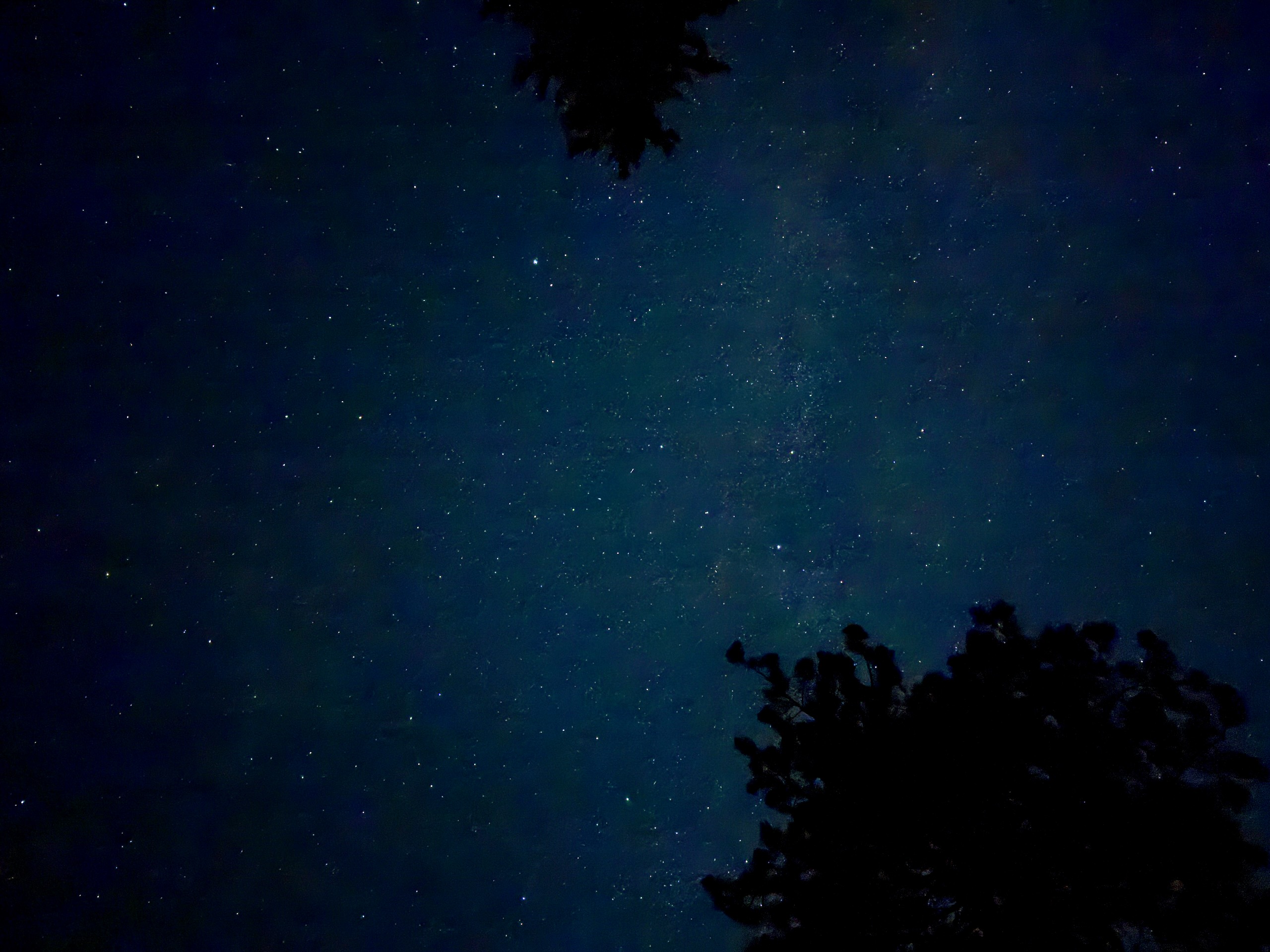
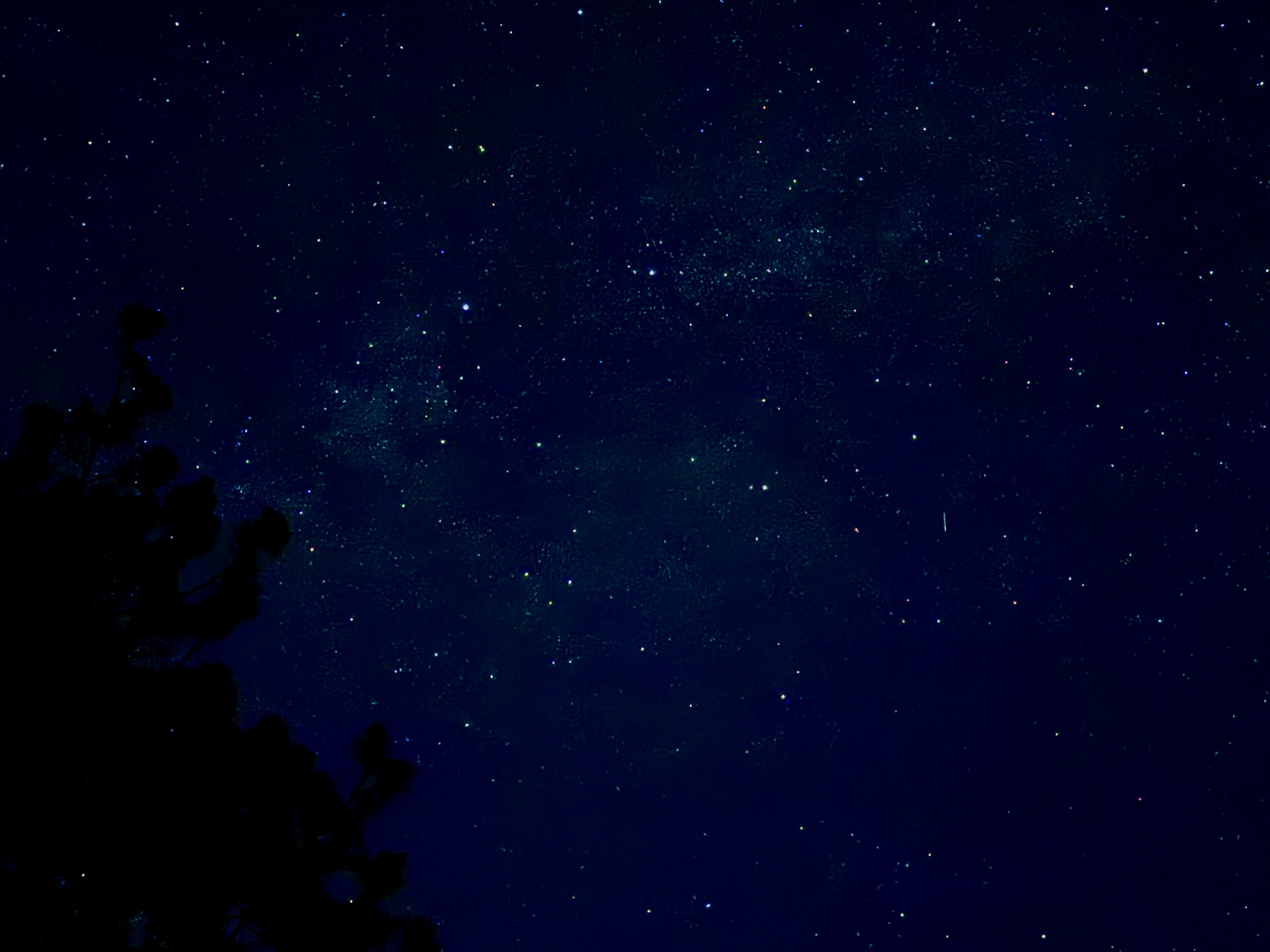
- The Milky Way runs straight through that triangle, from the northeast down to the south. It’s also the real test of a dark sky: where you can see it as a band, the sky is genuinely dark.
- Cassiopeia — the distinctive “W” in the northeast, climbing higher through the evening.
If you’re not an astronomer either, those three are enough to make the evening worth it.
How Dark Is the Sky, Really?
The honest answer: better than the city, but this is not a dark sky.
You can see stars, and far more of them than from Winnipeg. The difference is obvious the moment you look up.
But there’s light along the whole horizon. The city hasn’t gone anywhere — it’s forty-five kilometres away and it glows. There’s a road right there. And the thing we didn’t expect at all: combines were working in the fields that night, and we could hear them.
And this is where the Moon comes back in. There was none in the sky that night — so the light along the horizon had nothing to do with it. That’s pure light pollution, and it won’t go away on a darker night.
So the feeling of nothing and nobody around isn’t available here. You’ll be looking at stars while hearing civilisation a hundred metres away.
Mosquitoes, Coyotes and Combines
Three things we learned on site that weren’t in any recommendation.
Mosquitoes. In Winnipeg itself there are almost none by early September. Add the rain, the cool air, the fact that it’s autumn — we simply brought nothing for them. By the Wildlife Management Area sign there was a cloud of them. It’s a marsh, and September doesn’t change that. Bring repellent even if there are none at home, and long sleeves: you end up standing still, which is exactly what mosquitoes want.
Coyotes. We heard them. Didn’t see them, but heard them clearly enough to think about it. This is wild land and at night it behaves like wild land: don’t wander far from the car in the dark, don’t leave food out, and keep your dog close if you’ve brought one.
Combines. This isn’t only about the noise. One of them pulled out of a side road, saw us, and didn’t yield — though it should have. During harvest, farm machinery works through the night here: it’s large, slow, with limited visibility from the cab, and you shouldn’t count on being let through. Keep that in mind on the drive back.
Astronomy Night: The One We Haven’t Tried Yet
If astronomy is the goal rather than solitude, the centre runs a format that looks smarter than going on your own.
Astronomy Night is a monthly public astronomy evening at the Wetland Discovery Centre. The next one is September 17, 8 p.m. – 10 p.m. A theatre presentation first, then an observation session from the roof of the centre with their large telescopes, weather permitting.
- $10 for members, $15 for non-members
- Online pre-registration required
- Details and registration: Astronomy Night, Oak Hammock Marsh
We haven’t been — the event was still ahead of us when we went. But based on what we found at ground level, the conclusion writes itself: the roof puts you above every light on the property, the optics are serious, and there’s someone there to explain what you’re looking at. For this place, that looks like the best version of the evening.
If You Want Genuinely Dark Sky: Spruce Woods
If everything above tells you that “better than the city” isn’t what you’re after, Manitoba has exactly one official answer.
Spruce Woods Provincial Park, in the southwest of the province, was designated a Dark-Sky Preserve by the Royal Astronomical Society of Canada on September 4, 2022. It’s the first and so far only such site in Manitoba.
The difference isn’t a matter of impressions but of measurement: sky quality there reads 21.5–21.7 mag/arcsec², among the darkest in southern Manitoba. That’s helped by distance from towns and by what surrounds it — largely undeveloped land, including wildlife management areas and the CFB Shilo ranges. Park interpreters run night-sky programming through the year, and the Winnipeg RASC Centre holds an annual star party in the park.
The drive is about an hour and fifty minutes each way: west from Winnipeg on Highway 1, then south on PTH 5. That’s close to four hours of driving return, so it doesn’t work as an evening out. But there’s a campground in the park, and that’s really how to do it — stay the night rather than rush it.
We haven’t made it there yet, but that’s where we’re going next time we want dark sky.
Details: Night Skies, Manitoba Parks.
One Thing We Didn’t Know
From September 17 to October 12, 2026 the centre stays open until dusk, Thursday to Sunday. That means you can be there late and entirely legitimately during that window, with access to the grounds and trails.
We went on September 5, two weeks too early, and had no idea. If we were planning it now, we’d go inside that window.
The Centre by Day: Hours and Admission
We were only there at night and never went inside, so this is for completeness, from the official page.
- Hours: 10 a.m. – 4:30 p.m.
- Admission: adult $14, senior 60+ $12, youth 3–17 $12, family pass $46 (two adults and up to four children), free for members; GST on top
- Trails: over 30 kilometres — boardwalks, gravel and earth paths, and grass trails along the dykes
- Dogs: leashed at all times on the trails; inside the building only if you can carry them
Current hours and rates: Visit the Wetland Discovery Centre.
Who It’s For
- Anyone with two or three spare hours who wants to see more stars than the city allows — yes, the drive is worth it.
- Anyone who wants astronomy with a telescope and an explanation — book Astronomy Night; that’s the strongest version of this place.
- Anyone after genuinely dark sky with no trace of civilisation — this isn’t it. Go to Spruce Woods.
- With kids — better on the official evening: there’s seating, a washroom, and someone explaining things.
What to Bring
- Repellent — even in September, even if the city has none
- Long sleeves — you’ll be standing still
- A thermos — it’s cool in the evening, and coffee makes half the night
- A red flashlight — so you don’t wreck your own night vision or anyone else’s
- A blanket or folding chairs — looking up while standing gets old fast
Quick Reference
| What | Details |
|---|---|
| Where | 1 Snow Goose Bay, Stonewall, MB R0C 2Z0 |
| From Winnipeg | 45 km north on MB-7, about 34 minutes, paved all the way |
| Time needed | An hour on site was enough for us; three hours in total with the drive |
| Darkest spot | The pull-in by the Wildlife Management Area sign — no lights |
| Centre car parks | Usable after closing; the main one is well lit, the additional one less so |
| Sky | Clearly better than the city, but light along the whole horizon |
| September anchors | Summer Triangle overhead, Milky Way through it, Cassiopeia in the northeast |
| Noise | Road nearby; combines audible in the fields on autumn nights |
| Mosquitoes | Present even in September — repellent essential |
| Wildlife | Coyotes audible at night |
| Astronomy Night | Sept 17, 8–10 p.m., $10/$15, registration required, from the rooftop |
| Centre by day | 10 a.m. – 4:30 p.m.; adult $14, family $46 + GST |
| Open until dusk | September 17 – October 12, 2026, Thursday to Sunday |
| Real darkness | Spruce Woods Provincial Park, Manitoba’s only Dark-Sky Preserve, ~1 h 50 min each way |
Would We Go Back?
As an evening out of the city, it works. The drive is short and easy, the coffee was good, there are visibly more stars than at home, and the whole thing fits into three hours including the road.
But we went for something else. We wanted a sky with no hint of civilisation in it, and that isn’t what’s there. The city glows on the horizon, the road runs past, and that night the combines were still going late. And all of that with no Moon in the sky at all — meaning the conditions won’t get better than what we had.
So we’re still looking. Soon we’ll try Astronomy Night — the rooftop with telescopes looks like the smartest use of this place. And for real darkness we’re heading to Spruce Woods, which will get a write-up of its own.
If an evening out of the city is your kind of trip, we’ve also written up our evening trip to Big Tree Park.
Last checked: September 2026. We were at Oak Hammock Marsh on the night of September 5–6, 2026, roughly between 10 and 11 p.m. The drive, the three parking spots and the difference between them, the lights, the mosquitoes, the coyotes, the light on the horizon, the sound of combines and the behaviour of farm traffic on the road are all firsthand. We did not attend Astronomy Night, did not go inside the centre, have not seen the place in daylight, and have not yet been to Spruce Woods.
Sources checked: the official pages of the Wetland Discovery Centre at Oak Hammock Marsh — the Astronomy Night event page and the visitor page; the Manitoba Parks night skies page and the Spruce Woods dark-sky designation; lunar phase data for September 5, 2026. Prices, hours and event dates change — confirm before you travel.