



~35 minutes from Winnipeg. A small town, a wide river, and an outdoor museum we first mistook for boat storage.
Sometimes the best trips are the ones you expect nothing from.
This winter day in Selkirk started as a simple idea — “let’s just go for a walk.” No plan, no list of spots, no expectations at all. And it ended with the discovery of a small town with a big history, a walk past six real steamships sitting in the snow, and one of the most Canadian scenes I have ever witnessed in my life.
Let me tell you.
If you want a full guide to Selkirk Park — what is there year-round, the best time to visit, what to see — see our complete Selkirk Park guide. And if you are curious why we drove there with no plan in the first place — that is in our story about a spontaneous winter trip to Selkirk.
How We Ended Up There
The idea was our friend’s. He was working in Selkirk at the time — a small town north of Winnipeg — and suggested it: “Let’s drive up. Just walk by the river with a coffee, I’ll show you around.”
We did not have our own car yet (this was before Birds Hill and before our first Canadian vehicle), so we went with our friends in their car. A winter weekend, sun, no wind, the cold just barely on the freezing side. That kind of Canadian winter when you know it is cold outside, but the sun is so bright that you want to be out walking for hours.
The drive from Winnipeg took about 35 minutes on Highway 9 — straight, simple, no surprises. We had not looked up anything about Selkirk beforehand. We had not checked the map, had not read blogs. The plan was simple: walk a bit, talk, drive home. A perfect zero-expectation day, you could say.
Spoiler: that zero level got completely demolished in the first 30 minutes in town.
Meet Chuck the Channel Cat
The first thing that greets you when you drive into Selkirk is a giant catfish.
Standing in the middle of town, seven metres tall, smiling, painted in colour. This is Chuck the Channel Cat — a monument that was put up in 1986. As it turns out, Selkirk officially calls itself “Catfish Capital of the World.” The Red River in this area is famous for genuinely huge channel catfish, and the town takes its fishing reputation seriously enough to have made a smiling giant fish its unofficial mascot.
We stopped nearby, grabbed coffee at the closest place, walked up to admire this grinning giant. Took a photo, laughed, and moved on — our actual goal was a riverside walk, not staring at a monument.
But remember Chuck. He is not just decoration here. He sets the tone for the whole town: a little weird, a little fun, full of character. Selkirk is exactly like that.
First Impressions of the Park
Selkirk Park sits in the north of town, right on the banks of the Red River. Our friend parked, and we stepped out with those same coffee cups in our hands. The walk had just begun.
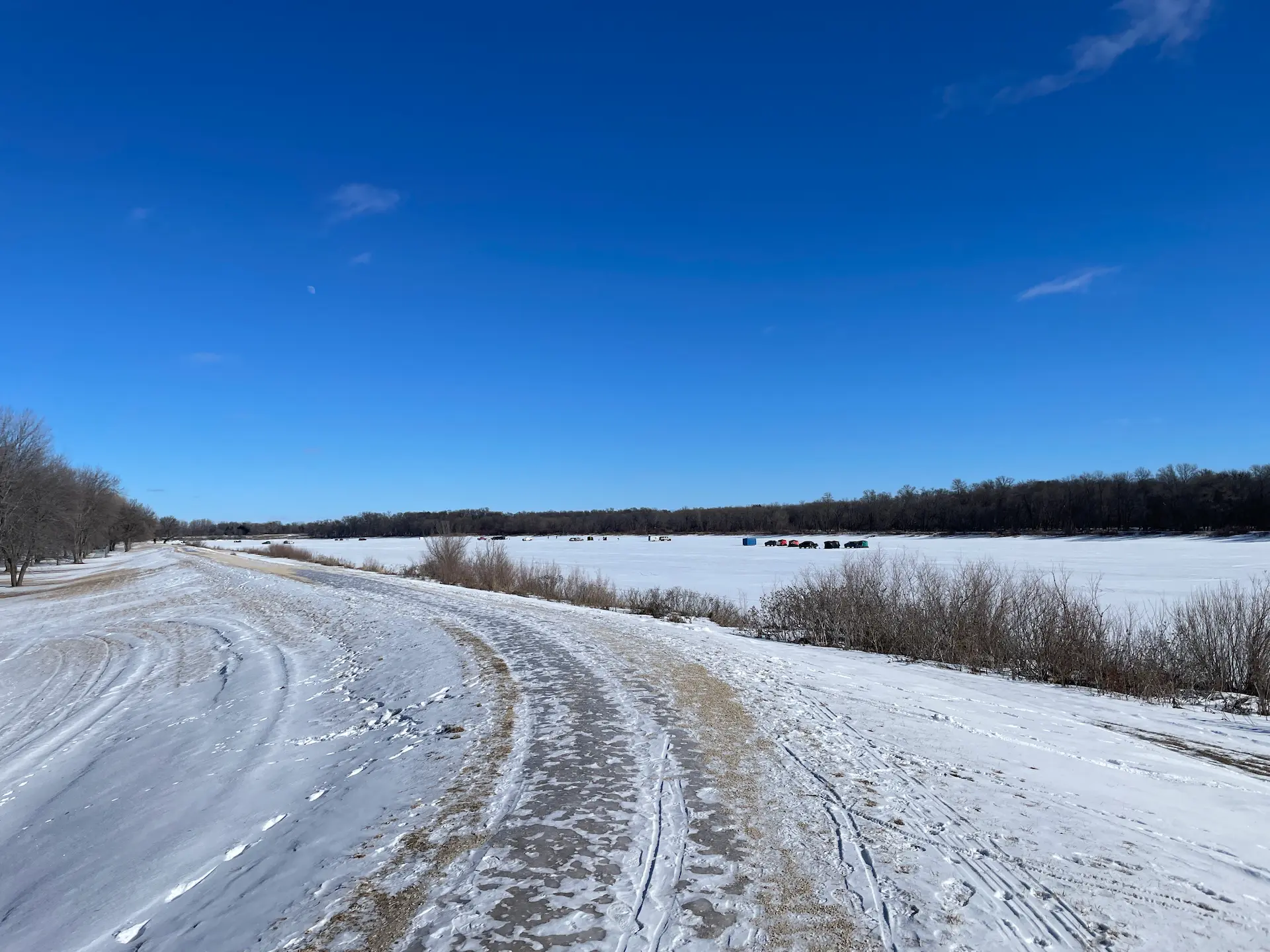
The park in winter looks quiet. A big open space, frost-covered trees, snow crunching under your feet. Few people — a couple of walkers, another pair with a dog in the distance. Most of the park’s facilities are closed until May — the pool, the campground, the boat launch — but it does not ruin the experience. If anything, the opposite. Without the crowds, the park feels different: like a place for quiet thoughts, calm conversations, for just walking and breathing without rushing.
We walked slowly, our friend told us about the town, we sipped our coffee. About ten minutes in, we noticed something in the distance. Large white shapes that clearly were not trees or buildings. With my eyesight (which is, let’s say, not exemplary), I could have guessed it was just a new species of local snowmen. But even my diopters could tell — something was bigger than that.
The Ships That Turned Out to Be Something Else
At first I thought it was just winter boat storage. I figured Selkirk was like Gimli — boats are pulled out of the water for winter and parked until spring. Somewhere there must be rails to get them back into the water once the ice goes. Logical, right?
Logical. Just wrong.
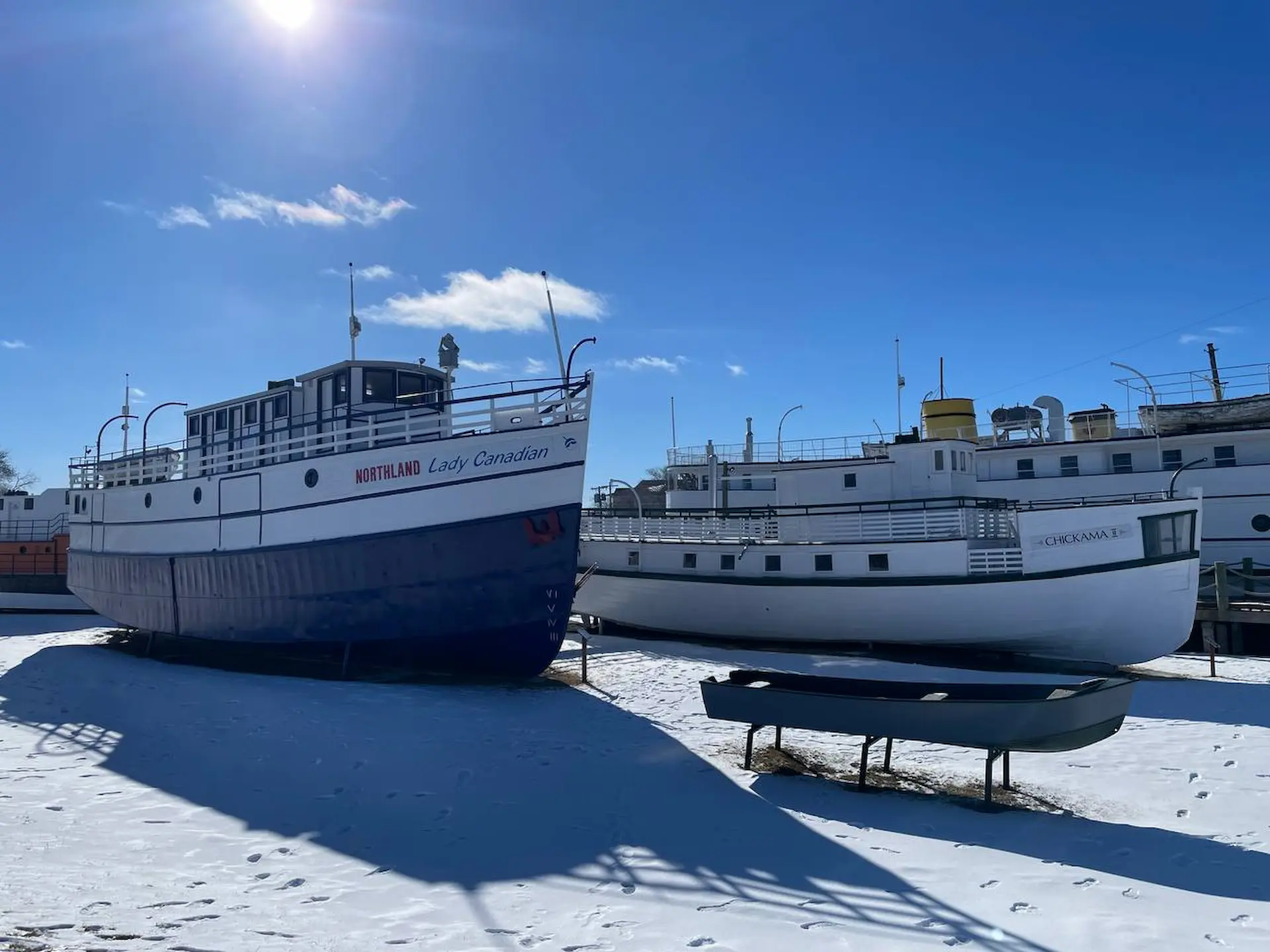
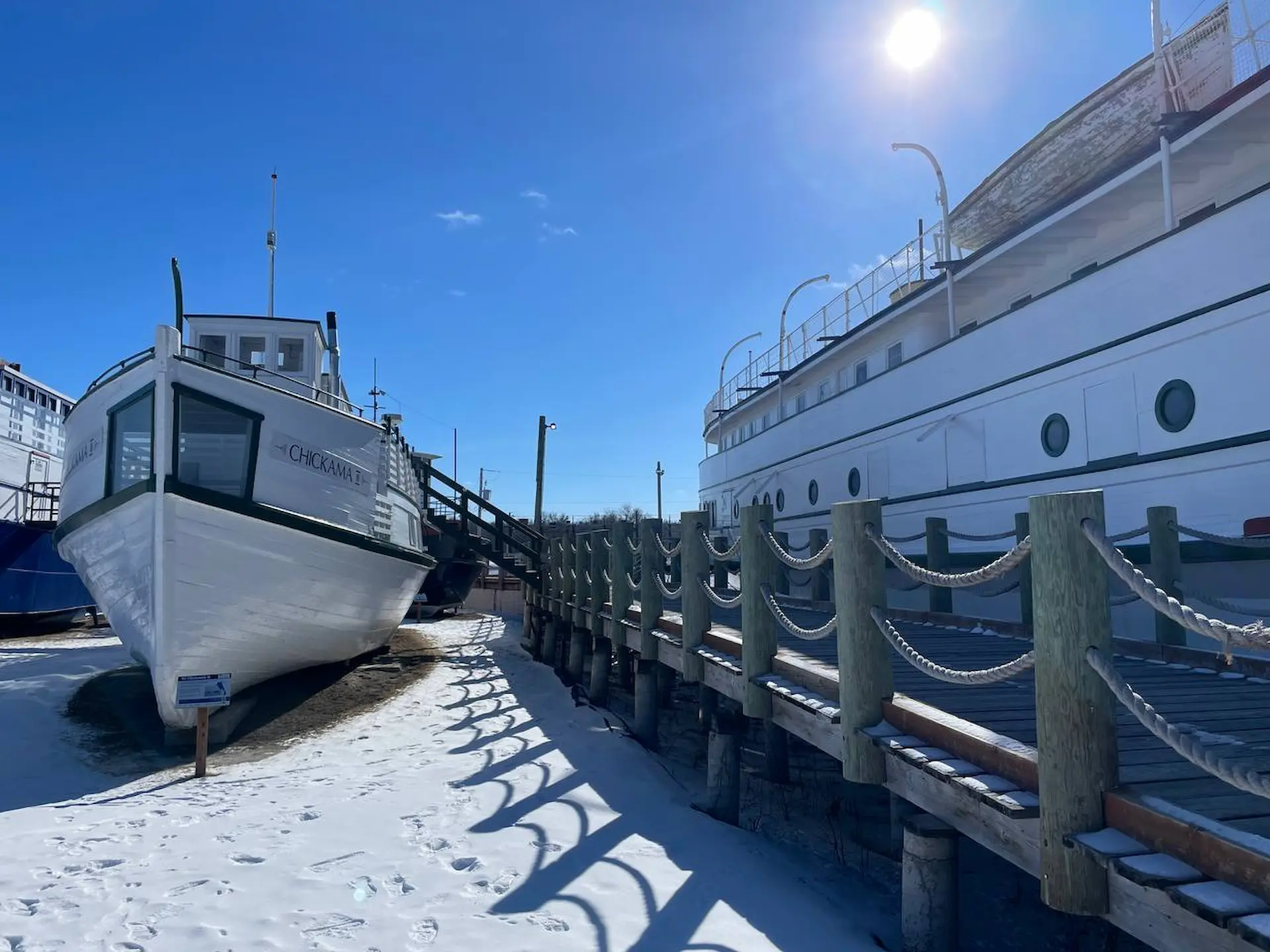
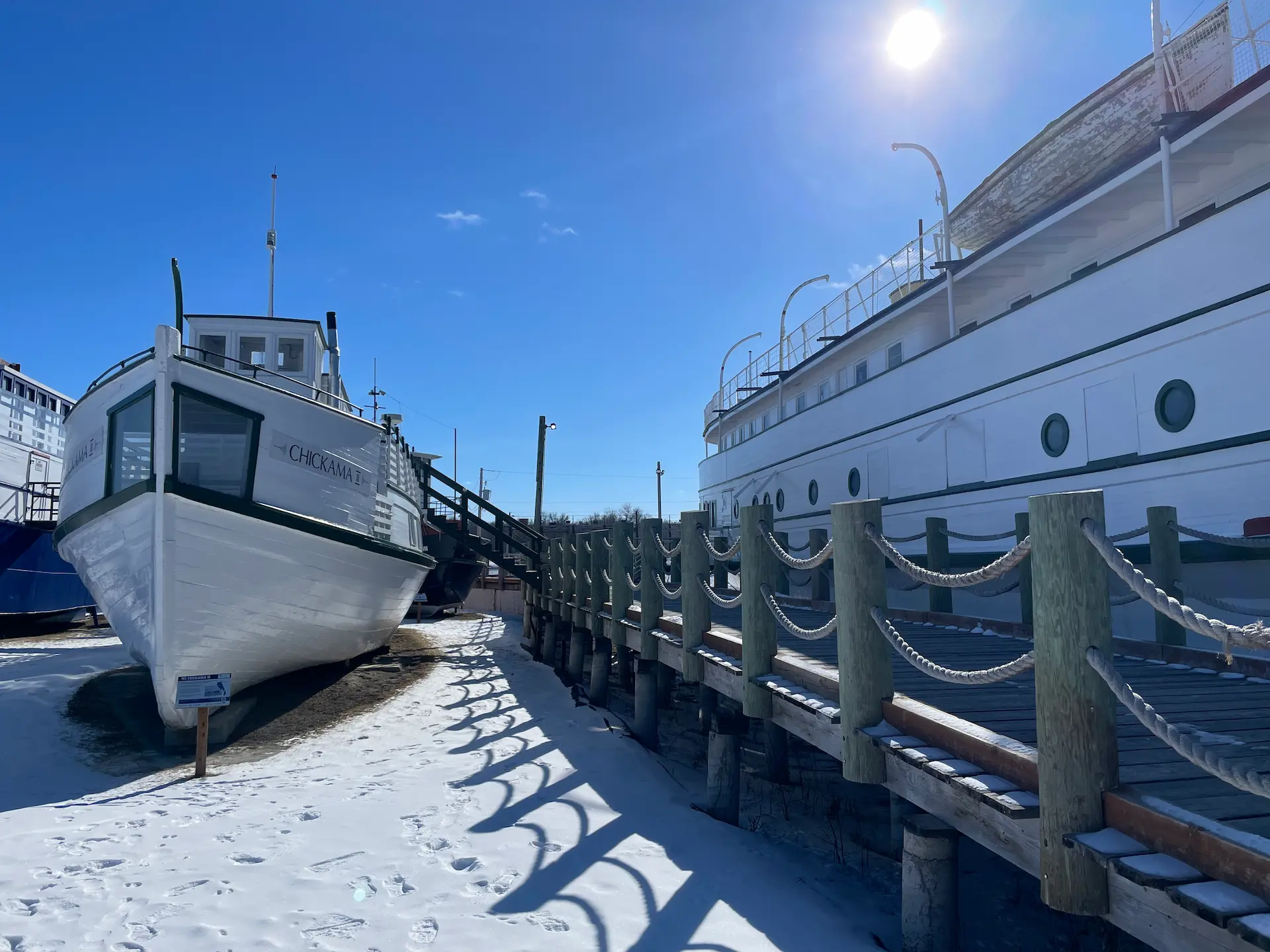
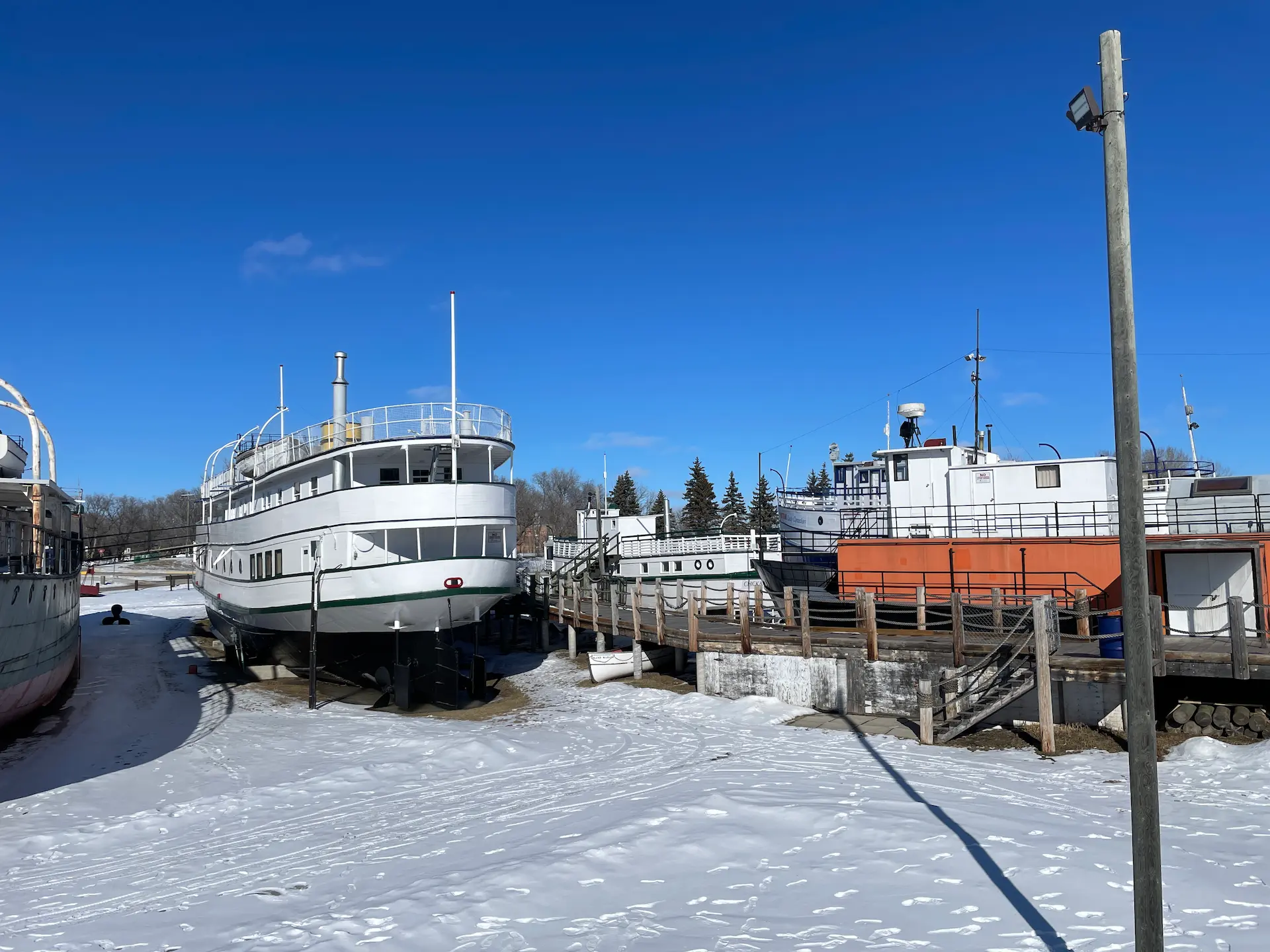
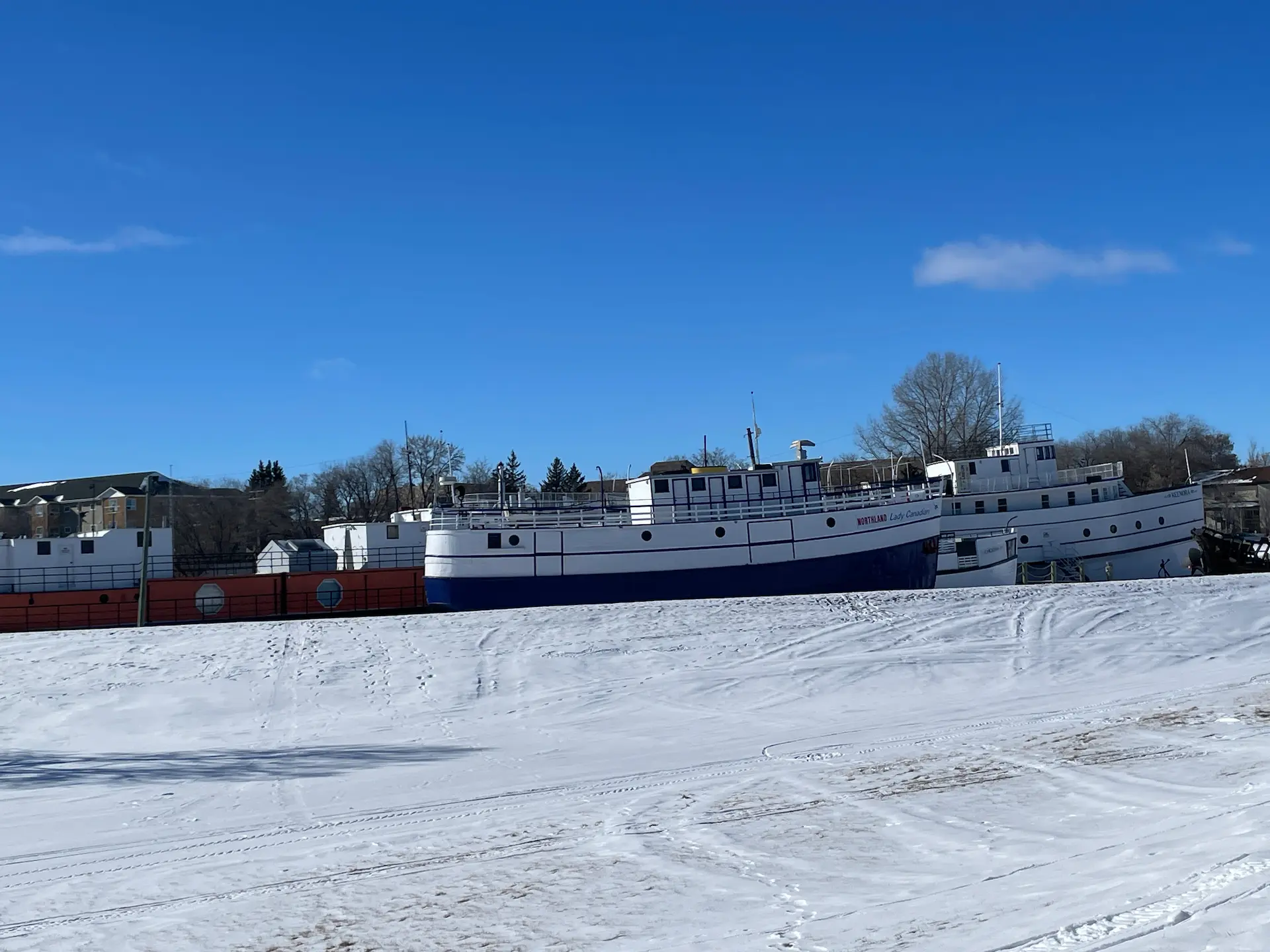
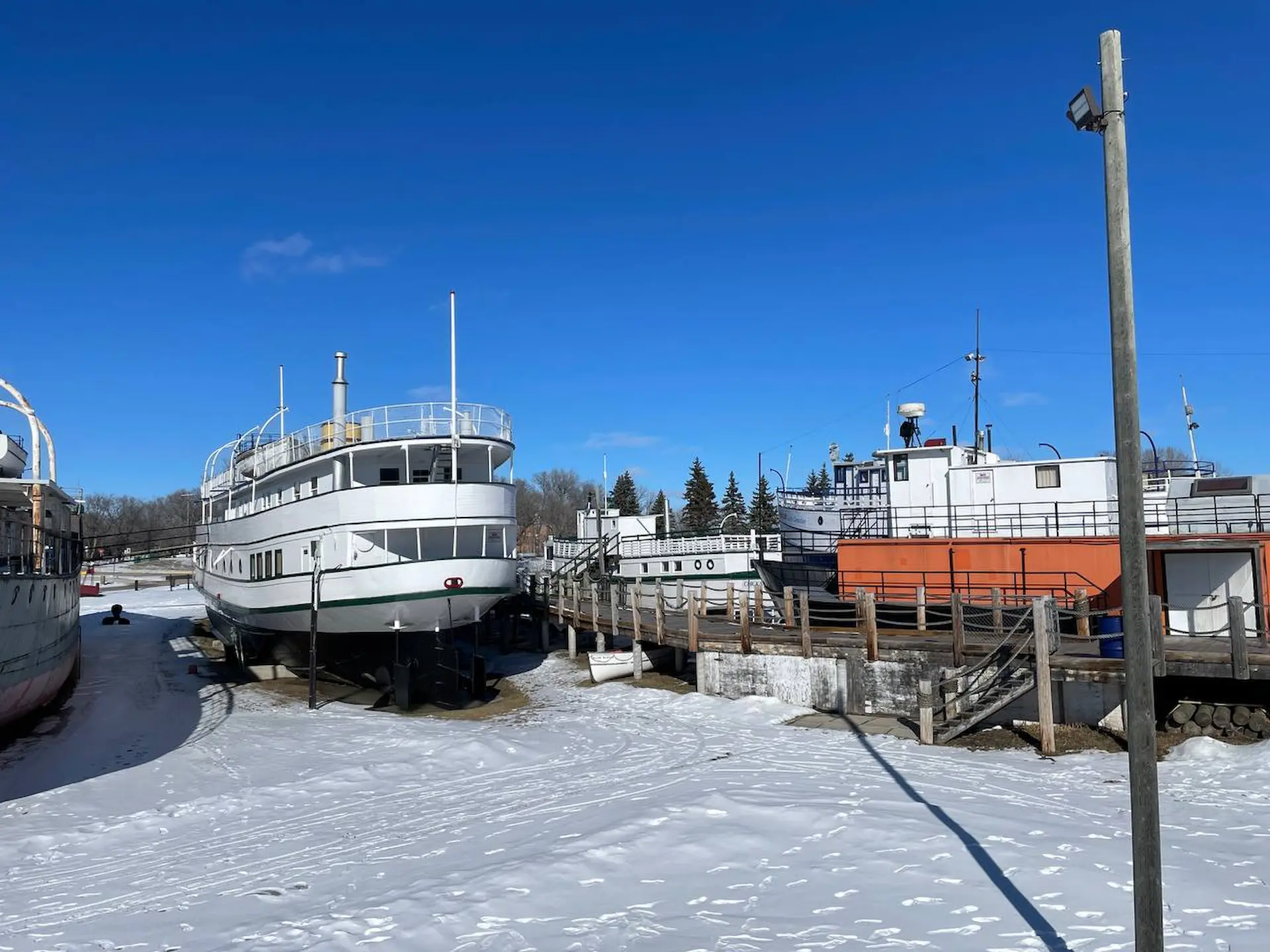
When we got closer, the picture changed. The ships were sitting too neatly — with wooden walkways between them, rope railings, like a real promenade. Each had a plaque with its name, service years, and short history. This was not seasonal storage — this was the Marine Museum of Manitoba, an outdoor maritime museum where the ships are permanent exhibits. They do not go back to the water in spring. They stay here for good.
The museum has been operating since 1972. Six historic vessels, each with its own story. Some of them — so wild that I did not believe them at first when I started reading.
S.S. Keenora — A Veteran With a Dancing Past
The biggest and most famous ship in the museum. The heart of the collection. And its history reads like a novel.
Built in 1897 in the US, it originally ran on Lake of the Woods, carrying passengers and cargo between remote communities. When a railway came through, the demand for the ship dropped. Around 1910, it was bought by a consortium of Winnipeg lawyers. They dismantled it into sections and shipped it by railway to Winnipeg in 1917.
Picture this: a steamboat, taken apart and loaded onto rail flatcars. In Winnipeg, they reassembled it, added another 9 metres to the hull, and got a 48-metre vessel with 65 passenger cabins and a top speed of 15 knots.
And then comes my favourite part of the story. Before becoming a real passenger steamer, S.S. Keenora spent one season as a floating dance hall in downtown Winnipeg. The lawyers who owned her made money from her that way before sending her out on her regular routes.
After her dancing year, S.S. Keenora was put on a proper run: Winnipeg → Lake Winnipeg → Warren Landing in the north. There, passengers and cargo were transferred to a smaller vessel that took them the last 30 kilometres to Norway House. Why the transfer? Because S.S. Keenora was too large to navigate the shallow Nelson River. For almost half a century, this ship was literally a lifeline for remote northern communities — carrying mail, food, medicine, people.
She survived the terrible storm of 1934, when Captain John Hokanson held the vessel steady against the wind for hours with 54 passengers on board. What stopped S.S. Keenora was not the lake — it was new safety regulations in 1965 that her old hull no longer met. She was supposed to be scrapped. Fortunately, she was saved — and since 1973 has been the centrepiece of the museum. Today S.S. Keenora is the oldest surviving steamship of Lake Winnipeg, over 125 years old.
C.G.S. Bradbury — The Ship That Broke Ice
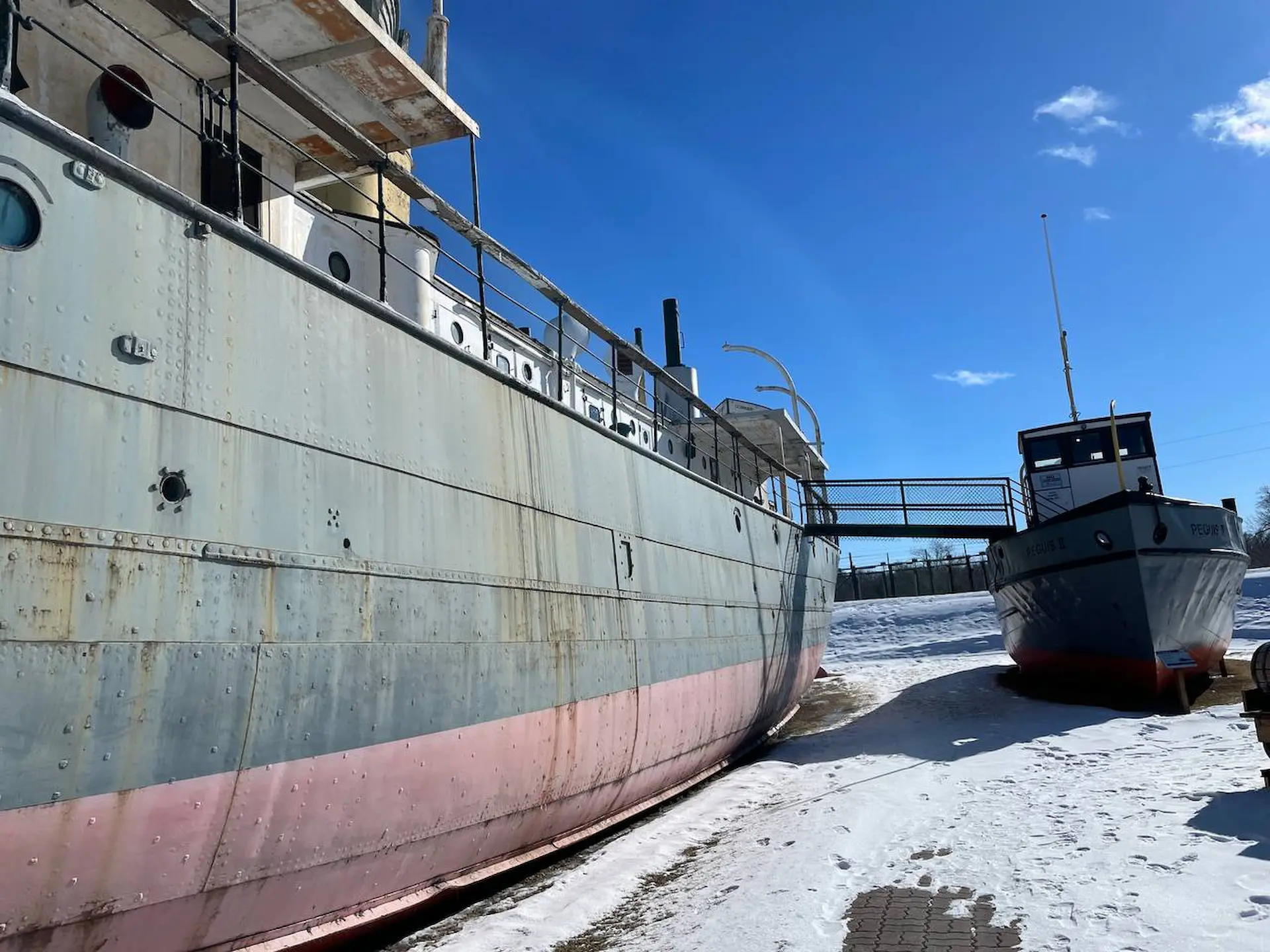
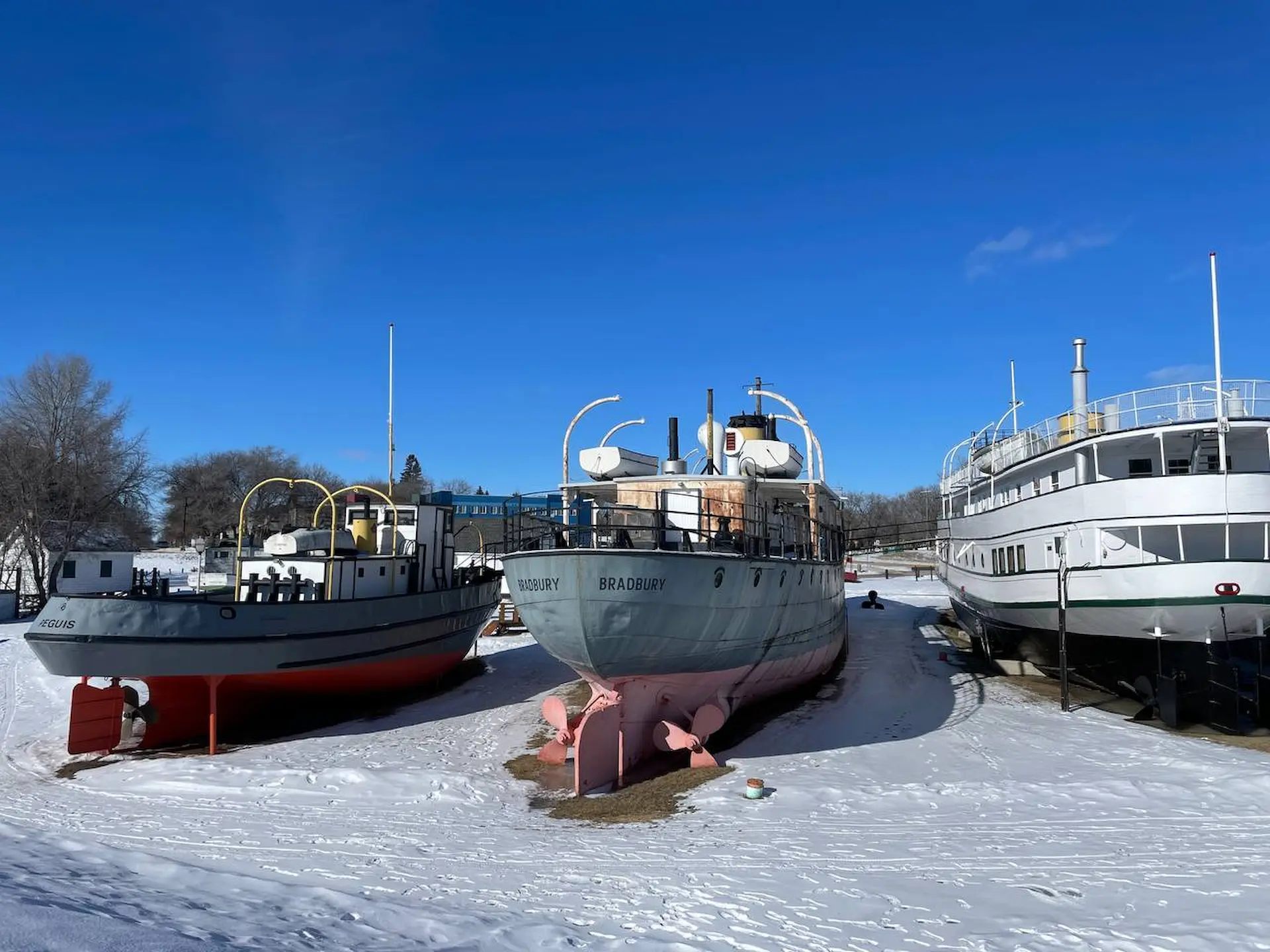
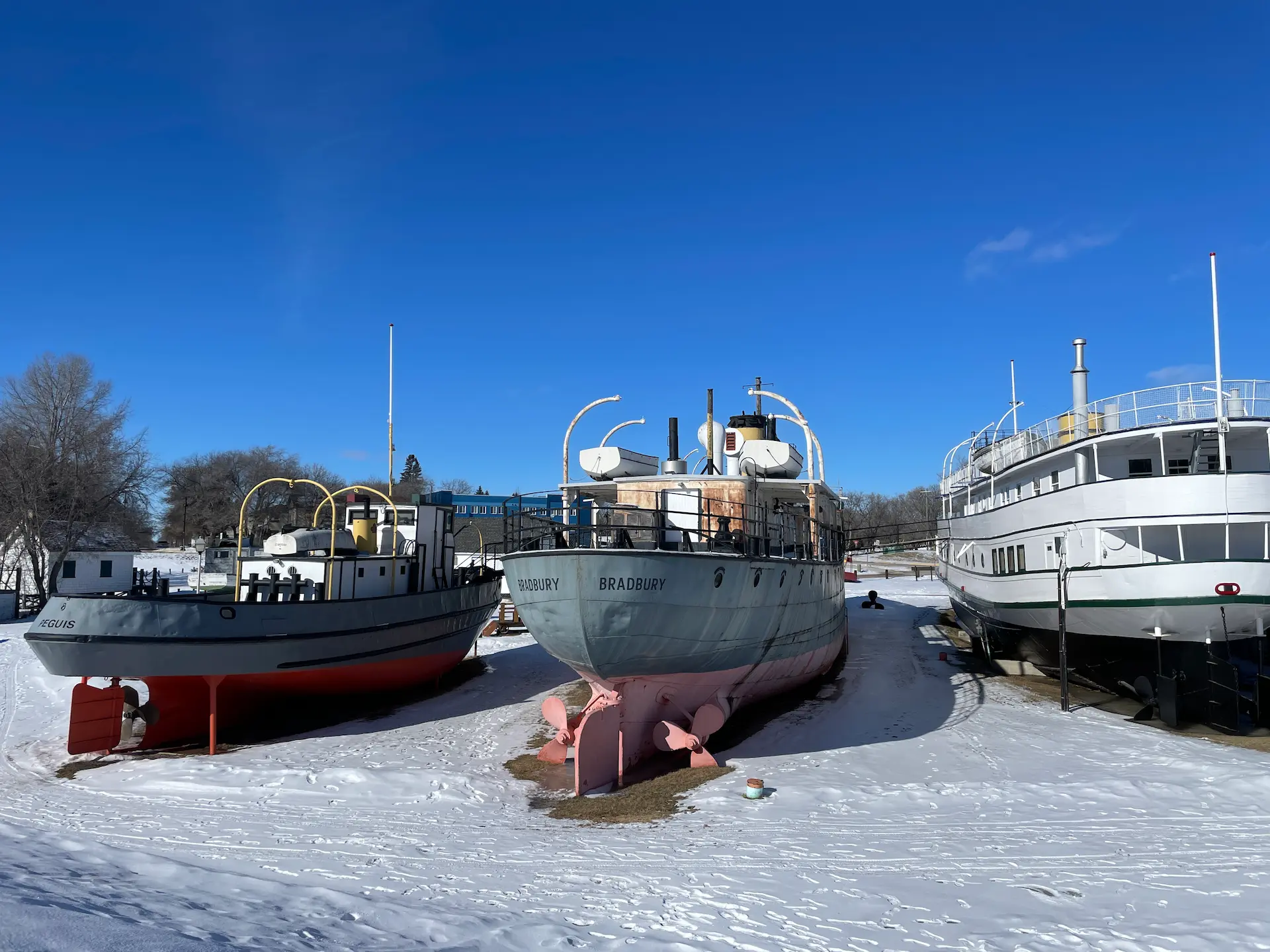
Next to S.S. Keenora stands C.G.S. Bradbury. The second-oldest ship in the museum. Built in Sorel, Quebec in 1915 and assembled right here on the banks of Selkirk slough. It served the federal government for nearly 60 years — as a fishing patrol vessel, a lighthouse tender (a ship that delivered supplies to remote lighthouses), and an icebreaker.
C.G.S. Bradbury worked until 1973, when she was finally retired. If you stand next to her and look at the hull, you can see how old icebreakers were built. Here, you can walk all the way around her, which you simply cannot do when a ship is in the water.
Joe Simpson — A Ship Named After a Hockey Player
Another ship — Joe Simpson — bears the name of a hockey legend. “Bullet” Joe Simpson was born in Selkirk, played for the local Selkirk Fishermen in junior leagues. Fought in World War One. Later — an NHL player and coach.
The ship was named after him. Built in 1963. And here is the most interesting technical detail: when Joe Simpson was built, she was fitted with the original diesel engines from S.S. Keenora. S.S. Keenora literally passed her “heart” to her successor. Joe Simpson had a flat bottom, so she could navigate where S.S. Keenora was too large — and took over her duties on the route from Warren Landing to Norway House.
It is almost a biological story. The old ship dies, and the new one beats with her old heart.
Joe Simpson was donated to the museum in 1994 and became the latest addition to the collection.
Chickama II, Lady Canadian, and Peguis II
Smaller, but no less important.
Chickama II — the smallest of them, looking like a stubby white launch. Built in 1942 right here in Selkirk by the Purvis Company. Her job was simple but essential: when S.S. Keenora arrived at Warren Landing, it was Chickama II that picked up the passengers and cargo and brought them to Norway House — places too shallow and rocky for bigger ships.
Lady Canadian — a fish freighter, built in Selkirk by Purvis in 1944, in the middle of World War Two. Nineteen years later, in 1963, she was significantly rebuilt. Her whole biography is work: hauling fish and cargo across Lake Winnipeg for Canadian Fish Products, later used by Manitoba Hydro as a research vessel.
Peguis II — a tugboat built for the Department of Public Works. She served on the lake from 1955 to 1974. The name honours Chief Peguis, leader of the Saulteaux people, who in 1817 signed an important agreement with Lord Selkirk about peaceful coexistence between settlers and Indigenous peoples in the region.
And There Was Also MS Lord Selkirk II
A separate story, but one worth telling. The ship is no longer at the museum. But without it, the story of Selkirk’s ships would be incomplete.
MS Lord Selkirk II was the largest inland cruise liner in Western Canada. 54 metres long, 12.5 metres wide, 800 tons in weight. Capacity — up to 400 passengers on day cruises and 130 on multi-day voyages. The ship was built in Selkirk starting in 1967, launched on June 9, 1969. She was christened by Mrs. Roland Michener — the wife of Canada’s then Governor General. The champagne bottle broke only on the second try. Not the best omen.
And her most famous passenger — Queen Elizabeth II. In 1970, during her visit for Manitoba’s centennial, she sailed on MS Lord Selkirk II together with Prince Charles, Prince Philip, and Princess Anne. In 1982, Princess Anne returned to sail on her again — this time for Selkirk’s own centennial.
And then came the slow decline. The ship was expensive to operate, the business was difficult, owners changed hands several times. In 1990 she made her final voyage. In 2010 she was sold for scrap. And on June 19, 2012, MS Lord Selkirk II caught fire — arson was suspected. The ship burned completely. The museum still has her anchor and lifeboat — the only memory of the giant once sailed by a queen.
A reminder that history does not always have a happy ending. And that preserving such things is work.
Something You Rarely Get to See
We walked around the ships slowly, reading the plaques, looking at the details. The museum is closed in winter — you cannot go inside. But it turned out there was plenty to see from the outside. Maybe even more than usual.
Because think about it: when you see a ship on the water, you only see what is above the surface. The deck, the hull side, the wheelhouse. Everything else — the hull below the waterline, the propellers, the keel, how deep the vessel sits — is hidden from you. Here, you can walk right up to a ship and see the whole thing. From below, the side, underneath — however you want.
How does something this big actually float? How do the propellers work? How much steel is below the waterline? These are questions that normally do not even cross your mind — but here, they come naturally. Just because the ship is no longer in water, but on snow.
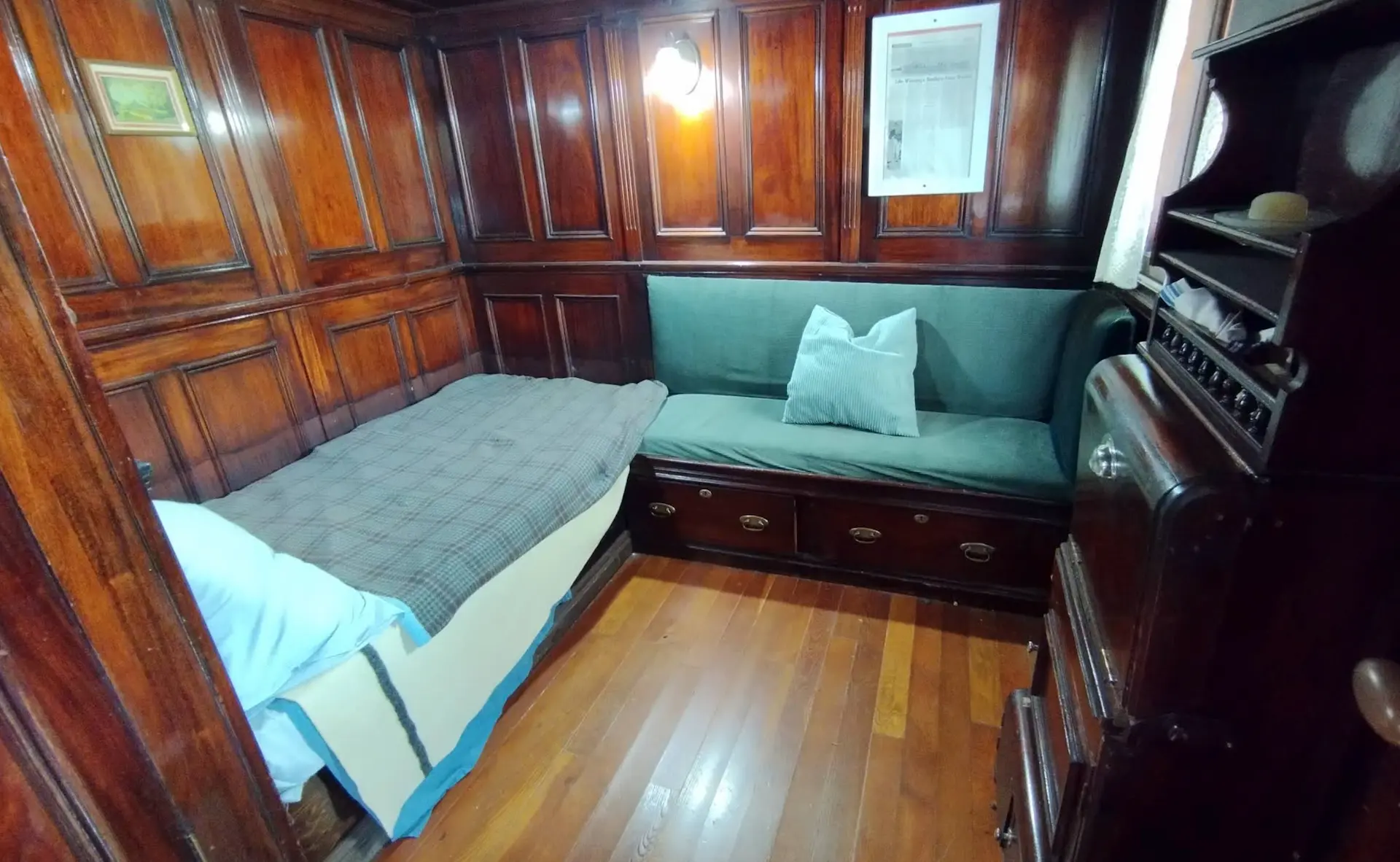
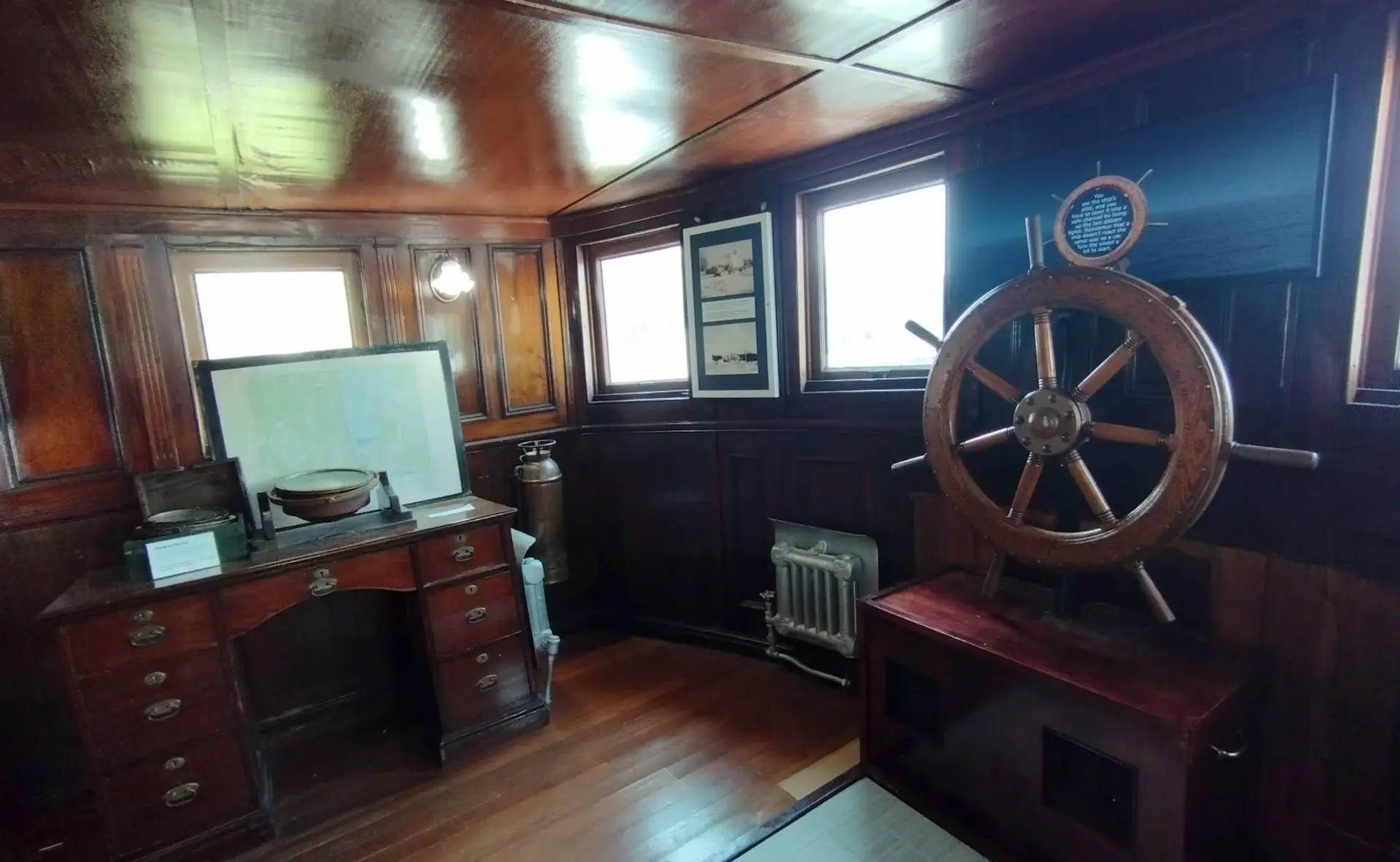
A shame the museum was closed, of course. I would have loved to step inside the wheelhouse of S.S. Keenora, see the cabins, the engine room of C.G.S. Bradbury. That is a reason to come back in summer — and we definitely will.
Walking Along the Frozen River
After the ships we kept going, along the trail that runs by the Red River itself. This is the Selkirk Community Trail Loop — about 5 kilometres, flat and simple. Perfect for a slow walk with coffee in hand and a conversation about everything.
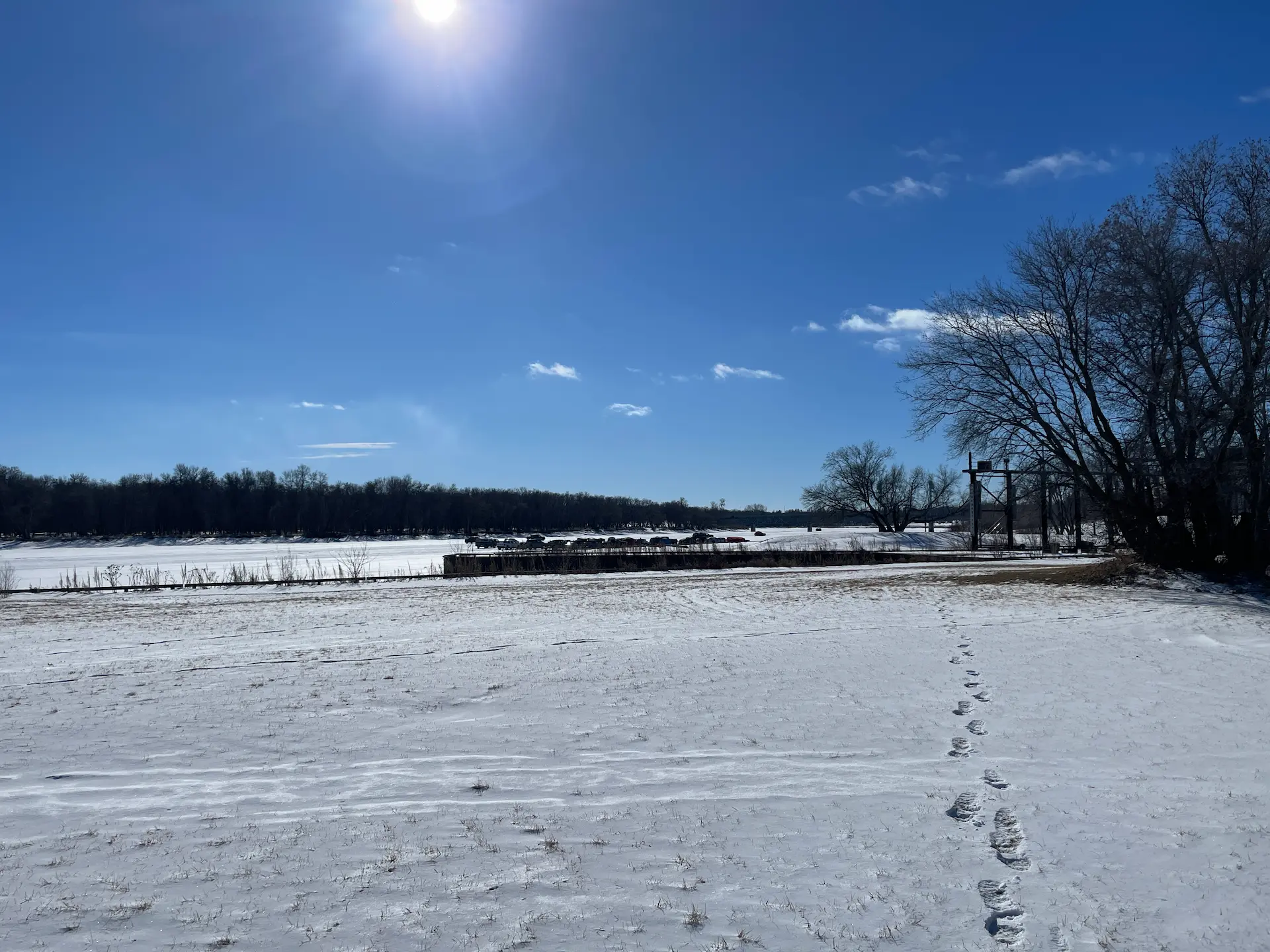
In winter, the river is not water — it is a white snowy expanse. Wide, flat, like a vast field stretching to the horizon. Trees on the other bank stand as black silhouettes against the sky. The sun reflects off the snow so brightly that your eyes squint even with sunglasses.
And here is where the thing that probably stayed with me longest from the whole trip was waiting.
Cars in the Middle of the River
Winter fishing was not new to us. People fish through the ice in Ukraine too — we have seen the picture many times. But Ukrainian winter fishing is one person, a bucket, a hand drill, a thermos. All on foot. Maybe a snowmobile in extreme cases.
But here, cars were sitting on the ice. Not on the bank. Not near the bank. Right in the middle of the frozen Red River. Dozens of them, parked on the ice — cars drove back and forth, between ice fishing huts (called ice shacks in local language). Someone bringing friends, someone bringing gear, someone, it seemed, just out for a drive on the ice for fun.
I know Manitoba winters are harsh. I know the ice here lasts not weeks but months. I know people have been doing this for decades and they know where it is safe and where it is not. I know that under normal conditions, the risk of falling through is minimal.
But my heart still tightens a little when you see an SUV calmly drive across what was a river just six months ago — a river that steamships used to sail on. We rarely see this on the Dnieper or Desna back home — Ukrainian winters are milder, and the ice cannot hold loads like that. Here, it is a different picture. Harsher nature dictates harsher daily life.
It looked simultaneously fun and unusual. A Canadian normal, with something deeply local about it.
We stood for a while watching. Ships behind us, the frozen river with ice shacks and cars ahead, sun, coffee, silence. One of those moments when you really understand where you live.
What We Took Away From This Day
This trip became one of those small lessons about Canada that are hard to catch right away.
When you live in a big city, you get used to a certain rhythm — everything is fast, everything has to be exciting, active, Instagrammable. Small Canadian towns like Selkirk work very differently. They do not rush. They let you slow down.
A walk with coffee. An unexpected catfish monument. Ships that turned out to be a museum with a century and a half of history. The S.S. Keenora that was once a dance floor, then spent half a century carrying doctors and mail across Lake Winnipeg. Joe Simpson with S.S. Keenora’s engine inside. The memory of MS Lord Selkirk II, on which a queen once sailed. A frozen river. Cars on the ice. And just a good day with friends.
Each of these discoveries added a small bright stroke to the day. Together they made up one of those winter days that stay with you for a long time.
How to Repeat This Day
If you want to do what we did, it is simpler than it sounds.
Leave Winnipeg on a sunny winter day — around 11:00–12:00, so you have time before dark. Drive north on Highway 9 — straight road, around 35 km and 35 minutes. Enter Selkirk, take a selfie with Chuck the Channel Cat in the town centre, grab coffee at the nearest local café.
Park at Selkirk Park — the address is 490 Eveline Street. Parking is free. Walk into the park along the paths — within 10 minutes you will see the Marine Museum with its six ships in the open air. Take your time — this is a place to walk slowly, read the plaques, look at the ships from different angles. Plan at least 40-60 minutes for the museum.
After the ships, follow the Selkirk Community Trail Loop along the river. 5 km full loop, but you do not have to do the whole thing. Walk as much as feels good, and turn back. On the river you will see ice shacks and cars on the ice — that is normal, and it is exactly what you came for.
If you have more time — Selkirk pairs naturally with Lockport, which is just 10 minutes south. You can combine: morning in Selkirk, dinner in Lockport.
What to Keep in Mind
Dress warmly. A Manitoba winter is not a joke, especially by a river where the wind has no obstacles. Hat, mittens, warm boots, thermal socks — non-negotiable. But you will be moving, so do not overdo the layers.
Hot drink in a thermos cup. Coffee, tea, hot chocolate — anything. Cold coffee in winter is borderline punishment. A warm drink in hand is warmth, mood, and an excuse to stop and look at something longer.
Ice fishing with cars on the ice is a local tradition. Watch from a distance, enjoy the view. Driving on the ice without local knowledge is a bad idea. If you want to try ice fishing yourself, organized outings are much safer than DIY experiments.
The museum is closed in winter (season is May–September). But walking around the ships outside is free, and it is its own kind of experience.
Winter boots with good grip — the trail has icy patches, and so do the parking lots.
What’s Next
Selkirk has stayed on our list as “a place we want to come back to.” In summer. Without snow. With Nika (it was too cold to bring her this time). For a full day, with the museum open, a walk along Selkirk Waterfront, and exploring everything that was unavailable in winter. The full park guide for all seasons I put together separately.
Manitoba is full of small towns that look different in winter than in summer. And in that, maybe, is its particular charm — every place can be seen twice, and every time as if for the first.
If you have a free winter day and half a tank of gas — go to Selkirk. With a coffee. Without a plan. See what happens.
Trip Summary
| What | Details |
|---|---|
| Start | Winnipeg |
| End | Selkirk and back home |
| Distance | ~35 km one way |
| Drive time | ~35 min on Highway 9 |
| Duration | half day, can stretch to a full one |
| Stops | Chuck the Channel Cat → Selkirk Park → Marine Museum → Red River trail |
| Budget | coffee + fuel (in winter park and ships are free) |
| Best time for winter visit | sunny day, late February–March |
| Dog-friendly | yes, on leash (small breeds — assess weather) |