


Sometimes the best plan for a winter day is the absence of one.
I have written before, in our post about the forty-minute rule, about how Bohdan and I stopped spending our weekends in front of a screen. That story started with Lockport — a spontaneous Saturday evening, a 1938 restaurant, and a hundred-year-old dam I first mistook for a bridge.
But the truth is, Lockport was not the first. The first was Selkirk. And it was the one that planted the habit that later became our rule.
Let me tell you.
How It Started
It was a regular winter weekend. Sunny, cold, but no wind — that kind of Canadian winter when it is freezing outside, but the sun is so bright you want to leave the house. We were sitting at home, drinking coffee, checking our phones. And our friend, who was working in Selkirk at the time, messaged: “Come over, let’s walk by the river, I’ll show you around.”
No plan. No prep. No “first we will do this, then that.” Just — shall we go?
We did not have our own car back then. So our friend picked us up, and we drove. Coffee in the car, talked about everything. The drive — 35 minutes on Highway 9. So short you do not even register that you are on a trip.
I knew nothing about Selkirk. Did not know there was a park there. Did not know if there was anything interesting. Did not even know there was a giant catfish monument in the middle of town (I wrote about it in detail in our story about a winter day in Selkirk, and I covered Selkirk Park itself as a place separately).
And that is exactly why the whole day was one continuous surprise.
What “Not Planning” Actually Means
There is an important nuance I only understood later.
“Not planning” does not mean “being unprepared.” We were dressed warmly, had coffee, brought everything you need for a winter walk. Our friend knew where he was going and where to park.
“Not planning” means something else: not telling yourself in advance what you will do, what you will see, how you will feel about it. Not reading reviews. Not looking up Google photos. Not building a picture in your head that reality will then have to match.
It sounds like a small thing. It is not a small thing. Because when you do not know what to expect, every step becomes a surprise. And surprises stick differently than expectations.
What I Did Not Know
I did not know there was a 100-acre park right in the middle of Selkirk.
I did not know there were six real ships sitting there — an outdoor maritime museum, closed in winter, but with the ships walkable from outside.
I did not know that S.S. Keenora — the oldest steamboat in that museum — had once been a floating dance hall in downtown Winnipeg.
I did not know that the ship Joe Simpson was built with the original engines of S.S. Keenora. That the old steamboat had literally passed its heart to its successor.
I did not know that Queen Elizabeth II had once sailed from Selkirk. In 1970, on the cruise liner MS Lord Selkirk II, which later burned in 2012. Only its anchor remains, now standing in the museum.
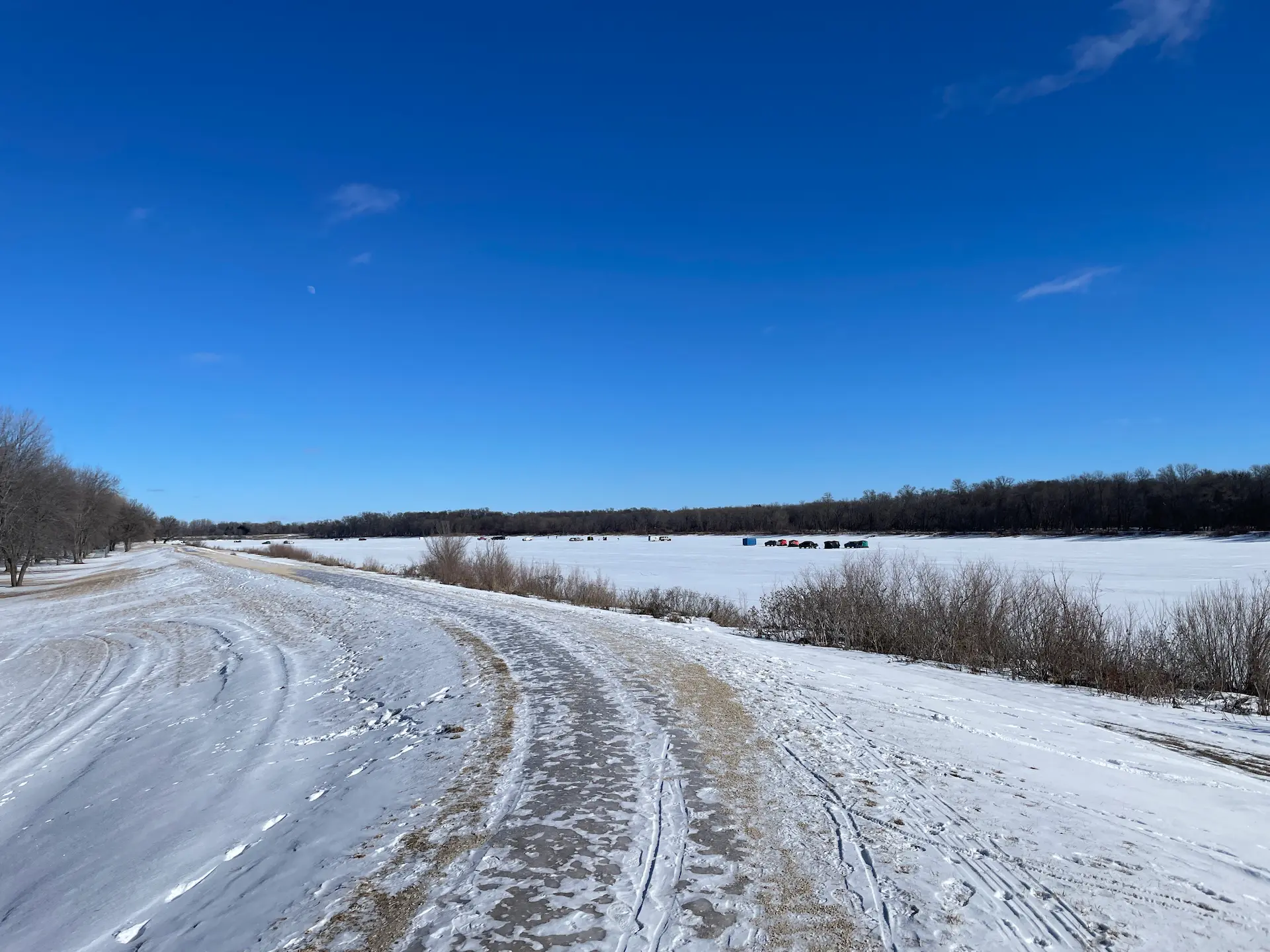
I did not know that on the Red River in Manitoba, people drive cars on the ice in winter. Right in the middle of the river. Dozens of cars parked on the ice, ice fishing huts, traffic back and forth — like a real highway.
And that is why, when I saw all this in one day, the effect was so strong.
Why Selkirk Stuck
Each of these discoveries on its own is just a normal fact. There was a steamboat. It was a dance floor. Engines were transferred. Okay.
But when you stand in the middle of a winter park, looking at a ship from 1897 literally sitting on the snow, reading on the plaque that it was once a disco in Winnipeg, while behind you cars drive on the frozen river — now that is a different story.
It is not just “interesting facts.” It is the moment when the world around you suddenly turns out to be far stranger and more complex than you thought. You came for a walk and got a small course in history, engineering, and Canadian winter culture in one day.
And all of it without a single line of planning. Just because a friend called. Just because we said “yes, let’s go.”
What I Realized
I thought about this for a while — why this trip became so important for me. Here is what I came to.
Small Canadian towns are not tourist attractions. They are not “selling” themselves. They are not trying to impress you. They have no Instagram ads, no must-see lists, no lines outside the main landmark.
What that means in practice: if you know nothing about them in advance, you arrive clean. With no filter of expectations. With nothing to compare to photos. With no “was it worth it” assessment.
And that is when the magic happens. A small unexpected find you stumble across in a quiet park feels brighter than a famous landmark you have already seen a thousand times in someone else’s stories.
It is an unfair experiment, I know. But it works.
How It Became Our Rule
A few months later we bought our first car. And everything changed.
First we tried again — drove spontaneously to Lockport one evening. The same thing happened. A small 1938 restaurant, a dam, a walk by the river.
Then Birds Hill. Then a few more places.
And at some point we realized that Selkirk was not random. It was the first example of the principle we now call “the forty-minute rule”: find a place within an hour’s drive, do not plan, just go.
If you are curious how this approach works — I wrote about it in detail in the forty-minute rule post. This post is about where it all started.
Permission
There is one more thing here that is hard to put into words, but I will try.
When you live in a new country — especially as an immigrant — you have a tendency to do everything “right.” Double-check. Read up on how things are done. Watch how others do them. Because you are still learning how it all works here.
Selkirk gave me something important: permission to do it differently. Not “right,” but “my way.” Not “the proper way,” but “the way I want it right now.”
We could have arrived in Selkirk “properly”: with a plan, with a list, with museum tickets bought in advance (which, by the way, would not have helped — the museum was closed for winter anyway). But we did it our way. And that is exactly why the day felt alive.
I still think it was one of the best Saturdays of that year. Not because of an achievement, not because of a great photo, not because of a checked box “saw the famous landmark.” But because of a feeling — we just lived a good day. Together. Without rushing.
And that is what I now look for every time a Saturday feels “empty.”
If You Are Reading This
This is not advice. This is not “try it.” This is just a story.
But if a Saturday ever feels “empty” for you too — try calling a friend and just driving somewhere. Without a plan. Without expectations. Just with coffee and time.
Maybe your Selkirk is already waiting for you.